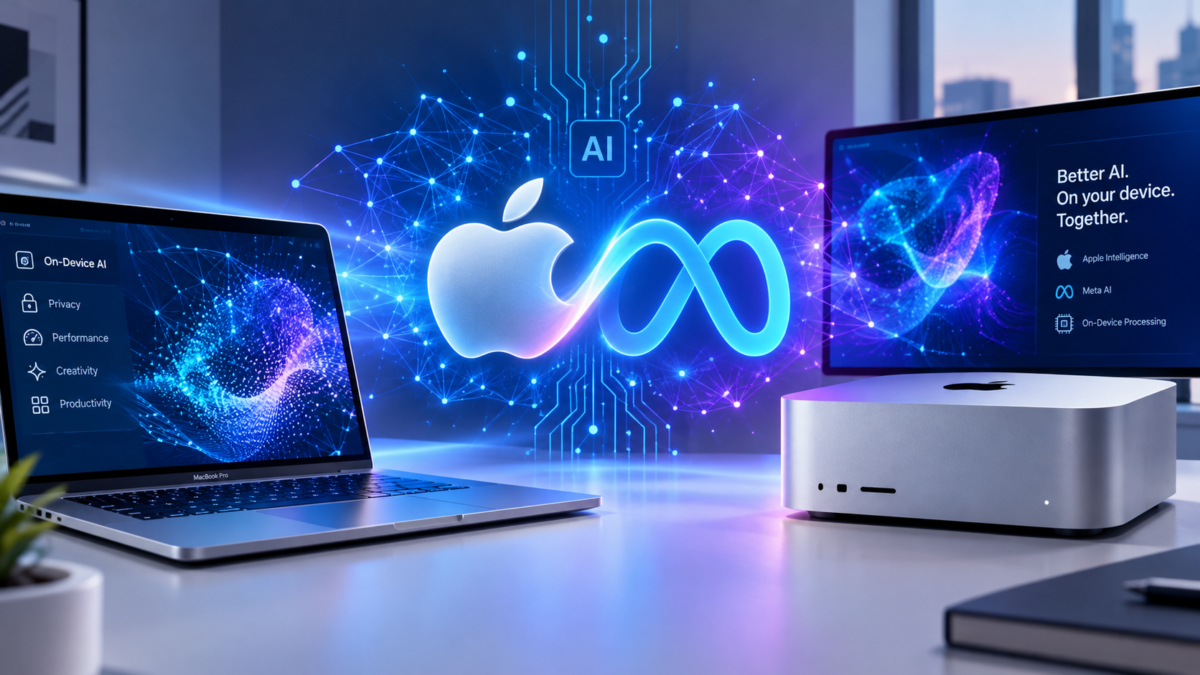
Meta and Apple Join Open Weight AI Model for M1: The Impact on On-Device AI Future
In a surprising turn of events, Meta and Apple have joined forces to develop an open-weight AI model for high-end Mac computers.
The collaboration, announced this week, centers on Meta’s newest release — Muse Spark Open — an 816-billion parameter, multimodal model which developers and users can download and run locally. Apple has updated its MLX software toolkit to optimize the model for Mac hardware, enabling sophisticated AI tasks to be carried out without relying on the cloud.
Meta and Apple: Past and Present Rivals in the App Store Space
The collaboration marks the first time Apple and Meta have partnered on an open-weight model. The two companies have long been rivals in the app store space — competing on features, security, and privacy. While Apple has a strong reputation for its privacy-first approach to app development and data collection, Meta has drawn criticism for its data harvesting practices on its platforms.
What Is Muse Spark Open?
Muse Spark Open is Meta’s newest open weight model, notable for its:
816 billion total parameters (only some of which are used per request, for efficiency)
Ability to process text, image, video and audio
Massive 1-million token context window
Strong coding and agentic capabilities
Ability to run on high-end Macs, including those with two Mac Studio machines
Unlike other ‘closed’ models from competitors, open weight means the core model components are available for download, for users to run on their own hardware (subject to Meta’s licensing terms, including some restrictions on commercial use).
Meta has designed the model for coding assistance and agentic capabilities — while acknowledging that some Chinese open models excel in coding benchmarks, Muse Spark Open represents a significant boost to the American open model ecosystem.
Why Is Apple’s Involvement Important?
Apple’s involvement in the project is significant — by updating its MLX software toolkit, Apple has made it possible for developers and users to run this large-scale model on their Macs. The collaboration has several implications for the future of on-device AI:
Developers can build and test more sophisticated AI applications locally, with greater privacy
Privacy-conscious users can take advantage of the model’s capabilities without exposing their data to third parties
Video/image creators can process their media on their local machine, reducing the need for expensive cloud-based services
It supports Apple’s broader goal of promoting more AI-centric devices, while also appealing to privacy- and security-conscious users
Broader Implications for the AI Industry
This collaboration comes at a critical time for the AI industry. While OpenAI, Anthropic, and Google continue to dominate the headlines with their closed models, the rise of open weight models has been a significant trend in recent months. These models offer greater flexibility and customization, while also addressing some of the data privacy concerns associated with closed systems.
Nvidia also announced the release of new open models in its Nemotron family this week, underscoring the growing interest among U.S. tech giants in the open model space.
At the same time, the market has become increasingly wary of the massive capital expenditures required for AI infrastructure. With some companies — including data-center operators — already facing debt burdens, the high costs of training frontier models have contributed to recent selloffs in the tech sector. Local, efficient models represent one way to address these concerns.
What Does This Mean for Everyday Users?
While the technical implications are significant, the most interesting applications of this collaboration may be closer to home. With the release of Muse Spark Open, Mac users can expect:
More sophisticated AI-powered features within creative applications
More advanced coding assistance tools that don’t rely on the cloud
Greater capabilities for document/image/video analysis, with reduced privacy risks
The emergence of new independent apps that take advantage of the open model
Developers will also be interested in the opportunity to build upon this robust, U.S.-based open model, with optimizations for Apple hardware.
The Future of On-Device AI Looks Bright (Especially for Mac Users)
Apple and Meta’s collaboration represents a significant step forward in the evolution of on-device AI. As competition between AI companies intensifies, we are likely to see further collaborations between open model developers and hardware manufacturers.
With more powerful, locally-run models becoming a reality, the balance of power between cloud-based and on-device AI may well shift. For now, Mac users and developers can look forward to a wave of new applications that take advantage of the capabilities of Muse Spark Open.