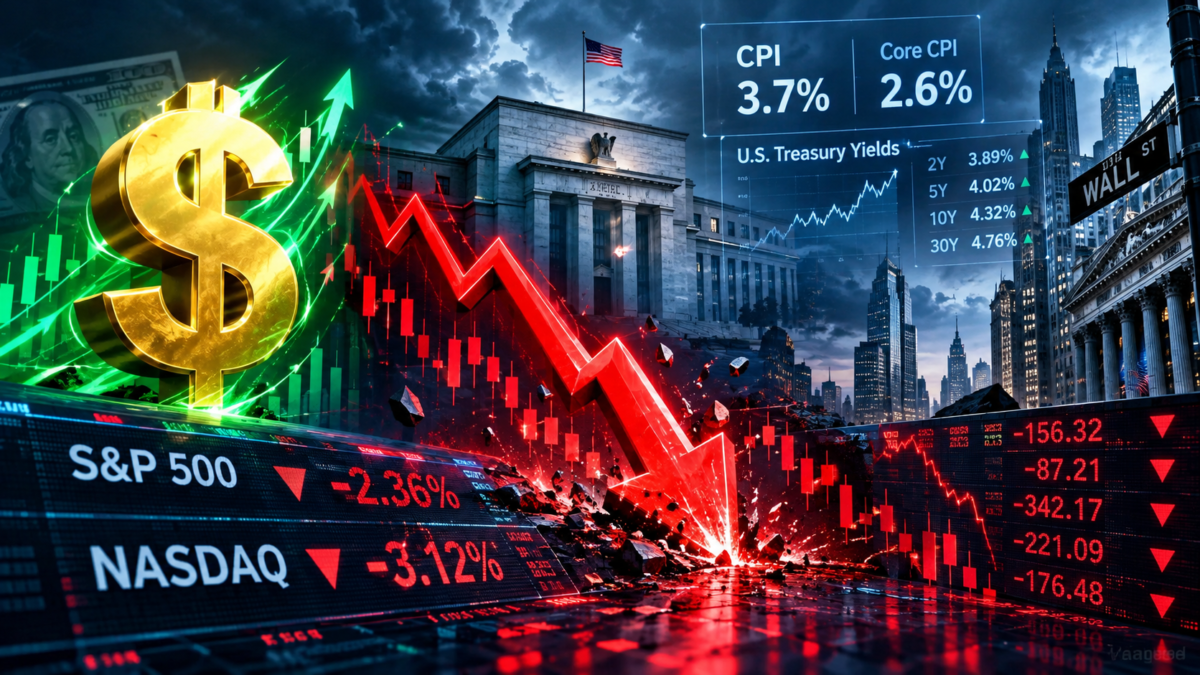
According to the latest data from the United States Department of Labor, inflation in the American market exceeded the expectations of Wall Street analysts for the second consecutive month. After the release of the report, the stock indices dropped significantly, the US Dollar Index jumped, and Treasury bonds increased.
A revision of the upward “dot plot” inflation scenario by the Federal Reserve’s (the US central bank) members is now discussed. The chances of a rate hike to combat the growth of prices are also increasing.
On Friday, October 14, 2026, the latest CPI data came out at 3.7% for the year against the forecast of 3.6% and 3.4% for the last month. Core CPI inflation accelerated to 0.3% on a monthly basis and 2.6% on a yearly basis, beating the estimates by the Street by 0.2%. The increase in the prices of goods and services is now approaching the upper limit of the 2% range set by the Fed.
Higher energy prices, including a record increase in oil prices of about $106 per barrel, prompted by the military situation in the Middle East, had a significant impact on the result.
As a result, stock indices suffered losses, bond yields rose with the likelihood of the Federal Reserve increasing interest rates, and the dollar index climbed.
As is common knowledge, the higher the inflation rate, the higher the target interest rate should be. One of the main indicators of whether the Americans would be heading towards a new rate hike in the near future – is the “two-year note yield.” It was “jolted to the highest level,” and the Dollar Index hit a two-year high. Although not substantially, the NY Dow “closed down slightly.”
Thus, in the short term, investors were disappointed by the prospects facing the American economy. They feel nervous about tightening the Fed’s monetary policy, which can be reflected in a “rate hike this month or later this year.” The probability of a decision to increase rates in the near future has grown several times.
Market analysts recommend to keep an eye on the latest information and the report on the Producer Price Index for signs of a slowdown in the rate of price growth. After two years of high rates, additional tightening by the Fed could “crush” the already weakened economy. A number of factors, from the situation in the world’s energy markets, is now driving the dollar’s popularity.
Meanwhile, the latest data comes amid news of banks’ worsening profit and worsening economic conditions in major economies outside of the US. Although inflation rates have been declining for two years, they remain “above the threshold for many years.”
It is worth recalling that for several months now, the stock market has been concerned about the prospects for inflation. The rate hike by the Fed, which could come after several months, may “hit the growth stocks hard, and technology, artificial intelligence, and biotech are now considered growth stocks.”
The increase in the prices of goods and services by 0.3% to a record high implies a negative effect on the population’s purchasing power and, hence, on the economy. Thereby, it imposes a new burden on the shoulders of the central bank on curbing inflation.
However, the current situation cannot be called critical. This statement is based on the assurances presented by the members of the Board of Governors of the Federal Reserve on the “possibility of further rate hikes soon.” Thus, inflation remains under the control of the authorized US bank. Nevertheless, to ensure its decline, quantitative tightening (QT), or the reduction in the amount of money, the Federal Reserve lends to commercial banks, is required.
We look upon today’s developments with interest and await further data releases that affect the world’s equity and bond markets and the foreign exchange market for the remainder of 2026.