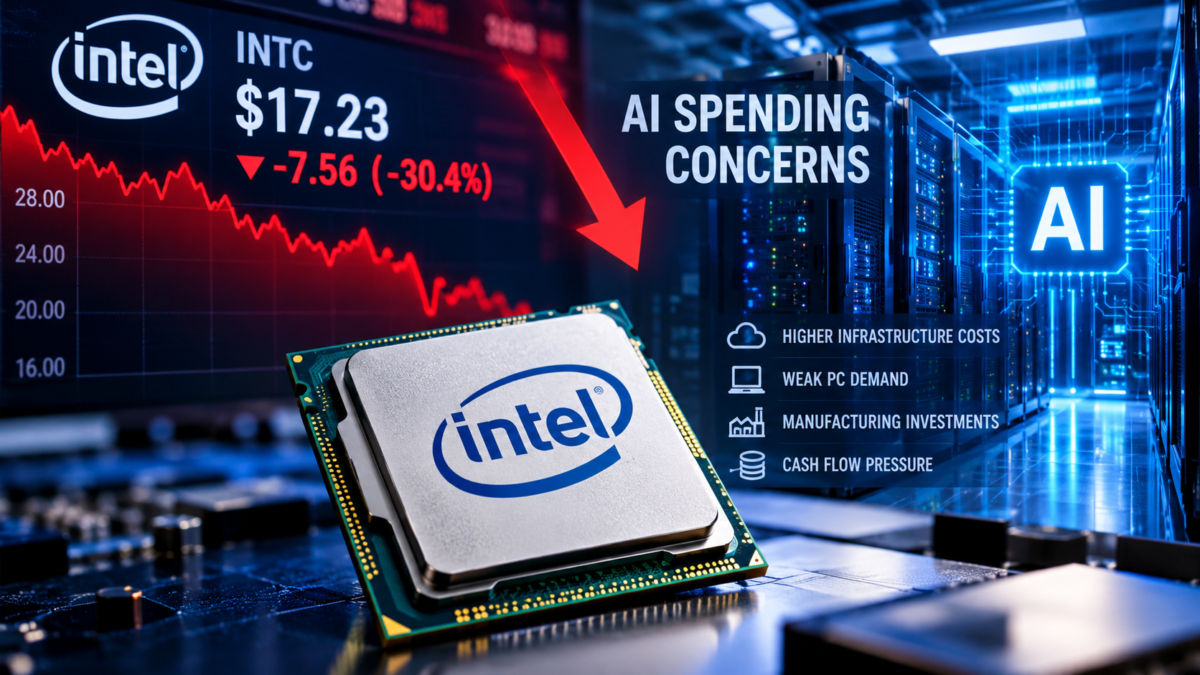
Intel shares fell nearly 30% on October 30 after the semiconductor giant reported disappointing revenue forecasts and said that it does not expect to see positive cash flow for 2026. This has caused further concerns regarding declining PC demand, increasing manufacturing costs and a large investment requirement for expanding artificial intelligence.
This has also impacted the sentiment of other semiconductor companies, such as Nvidia, AMD and Qualcomm.
The latest comment from Intel shows that the USA tech sector is increasingly under pressure. While demand for artificial intelligence is booming, the high costs involved in producing processors mean that the sector is under pressure.
Why did Intel fall nearly 30%?
On October 30, Intel shares fell around 30%, after the company released lower than expected financial guidance.
As reported by Reuters, Intel said it would see fourth quarter revenues of only $15 billion to $16 billion, which is much lower than the analyst average of around $17.07 billion.
It also said that it would not see positive cash flow in 2026.
Despite seeing third quarter revenues of $16.51 billion, up by around 21% year-on-year, the market was left disappointed.
This shows how quickly sentiment can change when the market feels that the company will not see growth in line with its valuation.
Cost of AI Infrastructure
Artificial intelligence is one of the biggest investment areas within the tech sector. Companies are spending heavily on new hardware, data centres, network infrastructure and computing power.
However, this is a large investment.
Manufacturing companies will have large costs in scaling up their production. This includes having the right equipment, infrastructure, and research. These costs can affect cash flow.
Intel is trying to boost its manufacturing to gain a share within the growing AI market.
While this can lead to long-term gains, it puts pressure on the company financially.
More and more investors are questioning whether tech companies can actually make enough money out of their AI investments.
Intel’s latest comments have caused more questions.
Declining PC Demand
AI is not the only issue for Intel.
With memory prices continuing to rise, demand for personal computers has been hit. This can cause issues for Intel as it is a major supplier of processors for desktop/laptop computers.
As reported by Reuters on 29 October, Intel saw a 5% drop in PC chip revenues to $8.10 billion in Q3. This was lower than analysts anticipated.
It also said that PC demand may continue to decline in the first half of 2027.
This puts the company in a tricky position. It needs to continue to invest in their core PC market but also invest in the new opportunities that AI is providing.
If demand does not pick up but costs continue to rise, then this can put further pressure on Intel’s margins.
Pressure on Intel Manufacturing Expansion
Lip-Bu Tan, the CEO of Intel, has been trying to help the company regain its competitive edge after years of issues within the manufacturing sector and increased competition from AI.
A key part of this has been boosting Intel’s manufacturing. This includes creating a strong contract chip manufacturing business.
This allows a manufacturer to make chips that have been designed by other companies, providing them with a new potential income stream.
However, creating a strong manufacturing business will involve large investment, cutting-edge technology and reliable processes. Customers must also want to use their facilities.
Intel has increased capital expenditure for 2026 to around $20 billion, as reported by Reuters.
It will also see increased costs in 2027.
While this can help the company in the long run, it puts more emphasis on keeping costs down.
Intel must find the balance between investing enough to stay competitive and keep costs down.
Pressure on Nvidia, AMD etc
Intel’s decline has impacted other semiconductor companies. Investors have been selling out of the sector.
As reported by Reuters, several major US chip companies, including Nvidia, AMD, Arm, Qualcomm, Broadcom and Micron also saw their shares fall on October 30.
Overall, this is due to concerns over the financial impact of the investment boom within AI. The high costs of infrastructure may impact several areas of the technology sector.
However, Intel’s issues do not mean all semiconductor companies are facing the same issues.
Each company offers different products, serves different customers and has different manufacturing models. For example, Nvidia has seen a lot of success within the graphics processor market, whereas Intel is trying to boost their position.
Overall, this shows how investors are re-evaluating the value of technology companies and how much they will get out of their AI investments.
What Does Intel’s Decline Mean For The AI Sector?
Intel’s latest issues show that just because there is increasing demand for artificial intelligence doesn’t mean that the companies providing the technology will see financial gains. While there are opportunities for chip companies, cloud providers and data centres, companies must also manage the costs of manufacturing, infrastructure, competition and demand.
Just because there is a lot of demand in certain areas doesn’t mean that all companies in the sector will see increased profits.
In the short term, Intel must focus on improving its manufacturing, reducing supply issues, improving their PC business and making sure they can get returns from their investments. Investors will also be interested to see if its manufacturing expansion will attract enough customers.
Overall, the whole AI sector will be under pressure, with increasing investment, investors will be looking to see clear evidence that the high investment in infrastructure will bring them enough returns.
What Next For Intel?
In the short term, Intel will be looking at the PC sector, memory prices, manufacturing and demand for data centre processors.
It will also need to keep costs down while they scale up.
It has said they will see lower revenues in Q4, meaning there may be further issues before things turn around.
Overall, Intel still operates in sectors with strong long-term demand. If they can improve manufacturing and take advantage of their efforts to expand within AI infrastructure, then they may see some opportunities.
However, this does not remove the risk of high capital investment and uncertain demand.
Investors will be looking for evidence that it can improve financially while still aiming to stay competitive in the long term.