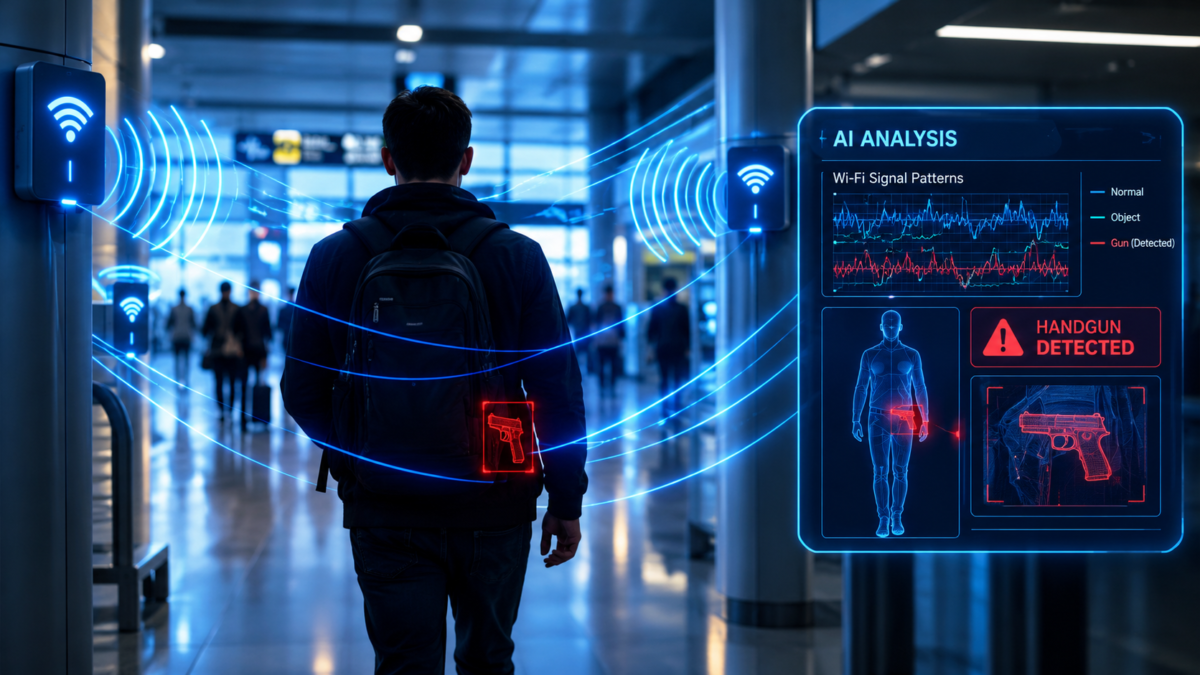
Researchers Develop AI for Detecting Hidden Handguns With Wi-Fi
Researchers have introduced WiFireNet, an experimental artificial intelligence designed to use Wi-Fi signals for detecting concealed handguns, which could represent a new layer of security at crowded places.
Researchers have found a way in which ordinary Wi-Fi signals could aid in the detection of concealed handguns without being reliant solely on cameras or conventional metal detectors. The experimental system, named WiFireNet by the researchers, makes use of artificial intelligence (AI) in order to recognize changes in wireless signals attributed to people and the objects they carry.
The research, published as a preprint on arXiv on October 13, 2026, looked into the possibility of using wireless sensing in order to discover potential weapons within indoor environments. The project has been completed by Erik Persson, David Gustafsson and Tomas Wilkinson, affiliated with Sweden’s Defence Research Agency (FOI).
The researchers note that the findings illustrate the potential of Wi-Fi based weapon detection as a supplementary technology to enhance security. However, the system still requires further testing for it to be considered suitable for real-world security screening. [Read the research paper on arXiv]
How AI Detects Hidden Handguns With Wi-Fi
Traditional security systems rely on metal detectors, imaging equipment or even surveillance cameras. Each have their limitations, especially when objects are hidden or there are many individuals who need to pass through the security checks.
WiFireNet approaches the matter by analyzing channel state information (CSI), which provides a description as to how wireless signals travel from a transmitting antenna to a receiving one.
When Wi-Fi signals encounter people or objects they can be absorbed, reflected or scattered. These interactions will then change the signals that are received in nearby equipment.
An AI model can be trained to recognize patterns and then apply what it has learned in order to determine objects that are associated with certain signals.
The researchers trained WiFireNet to recognize concealed handguns using a dataset that includes wireless measurements with simultaneously captured camera footage. This allowed the model to learn the correspondence between objects and their corresponding Wi-Fi signal patterns.
With WiFireNet trained, the system was engineered to make use of Wi-Fi channel information instead of needing to capture camera images when making its detections.
What Is WiFireNet?
WiFireNet is a deep-learning model that has been designed to detect concealed handguns using wireless sensing.
The researchers created the WiFire Dataset by capturing Wi-Fi measurements alongside RGB video of people carrying different objects. Objects that have been incorporated include real handguns, plastic handgun replicas, mobile phones and metal water bottles.
The inclusion of everyday objects to the training set is crucial as a security system would not only need to be able to detect unusual signal patterns, but also learn to differentiate weapons from common items that people carry.
The researchers were able to train an AI model to detect a handgun using the dataset that includes wireless measurements.
The team has also made the resources, including the dataset, model and code, available to others so that further investigations can be carried out.
How Accurate Is Wi-Fi Based Handgun Detection?
The initial findings suggest that Wi-Fi signals do contain valuable information that can be used in the detection of concealed weapons. However, the reported results also illustrate the limitations of the system.
When tested in a controlled indoor environment with up to four moving individuals, WiFireNet achieved an average handgun-detection precision of around 72.5% with the less restrictive localization evaluation. When a more precise localization of the weapon on the person carrying it had to be detected the reported precision dropped to approximately 53.8%.
These are experimental object-detection scores and not an indication as to how accurately the system will be able to screen the same percentage of people in an airport, school or public venue.
The distinction is important as real-world security systems need to be reliable across a range of body types, objects, movement patterns, room shapes and wireless conditions.
The prototype also had difficulty in unfamiliar indoor environments, suggesting that the performance may change when the system is exposed to different ones than what it was trained on.
The findings are an early demonstration of the potential that Wi-Fi has, rather than an indication that it has already replaced conventional security screening technologies.
Could Wi-Fi Weapon Detection Enhance Public Safety?
If the technology proved to be reliable Wi-Fi based sensing could offer an additional avenue of discovery for potential security threats.
One of the advantages of using wireless signals would be that they can operate without the necessity of every person walking individually through a conventional metal-detection gate. In a suitable environment a network of transmitters and receivers could monitor a wider indoor area.
The technology could eventually complement existing security arrangements in transport facilities, public buildings, event venues and other locations in which conventional screening has limitations.
Wi-Fi sensing could also be useful in situations in which cameras are unable to directly see an object due to it being concealed beneath clothing or out of view.
However, these are potential applications as the findings do not indicate that WiFireNet has already been deployed in airports, stadiums, schools or other high-security locations.
Any practical implementation would require extensive testing to determine its detection reliability, operating range, response time and ability to work in crowded environments.
Why The Researchers’ Approach Matters
The WiFireNet project is just one of many that have looked into making use of artificial intelligence to extract information from wireless signals beyond their conventional use in connecting devices to the internet.
Researchers have looked into Wi-Fi sensing for a variety of purposes such as human activity recognition, movement monitoring and detecting concealed metallic objects. In earlier research published through IEEE, for example, the use of commodity Wi-Fi radios and deep-learning strategies have been looked into in order to distinguish between metal and non-metal scenarios.
A related 2025 study published in the International Journal of Communication Systems investigated wireless sensing for concealed metallic-object detection, reporting promising results in controlled indoor experiments.
These findings suggest that wireless sensing could be a valuable research area for security and monitoring applications. However, detecting metallic objects is not the same as reliably recognizing a concealed handgun especially when there are several people present and everyday objects.
WiFireNet builds on this by focusing on the aspect of detecting handguns and using both visual and wireless data in the training of the model.
Privacy Concerns And Technical Challenges Remain
The possibility of detecting concealed objects through Wi-Fi also raises concerns regarding privacy.
Unlike conventional cameras wireless sensing may extract information regarding people and their surroundings without producing a conventional image of the scene. Depending on how a future system is designed, this could make it less obvious to people that sensing is taking place.
Before widespread deployment the rules as to how sensing will be governed would need to be established, governing consent, data collection, storage, access and use of automated alerts.
Another concern is with regard to technical reliability. Wireless signals are impacted by the surrounding environment, including walls, furniture, movement and interference from other devices. A model that was trained in one environment may not have the same level of performance in another.
False alarms could also create unnecessary security interventions and missed detections could provide a misleading sense of safety.
For these reasons, any future deployment would need independent validation, transparent performance reporting and human oversight. Wi-Fi based detection should not be seen as proof that someone is carrying a weapon or a replacement for established security procedures.
What Happens Next?
Further research will be needed in order to determine how well WiFireNet performs beyond its initial experimental setting.
The next steps include evaluating the model across a wider range of indoor environments, improving its ability to distinguish weapons from everyday objects and assessing how reliably it can identify the person carrying a detected object.
The researchers have also indicated that the open-source release is intended to enable continued investigation and improvement.
More extensive testing will be necessary before the technology can demonstrate the consistency that is required for practical security applications.
Conclusion
WiFireNet is an example of how artificial intelligence could potentially use Wi-Fi signals in order to detect concealed handguns without relying solely on cameras or conventional metal detectors.
The early results are promising, although the system’s limitations are significant. The performance that has been demonstrated in controlled experiments does not establish that it will be able to reliably screen crowds or operate as a standalone security solution.
For now it is an emerging approach to wireless security sensing. If future studies enhance its accuracy, reliability and privacy safeguards Wi-Fi based weapon detection could eventually supplement existing security technologies.