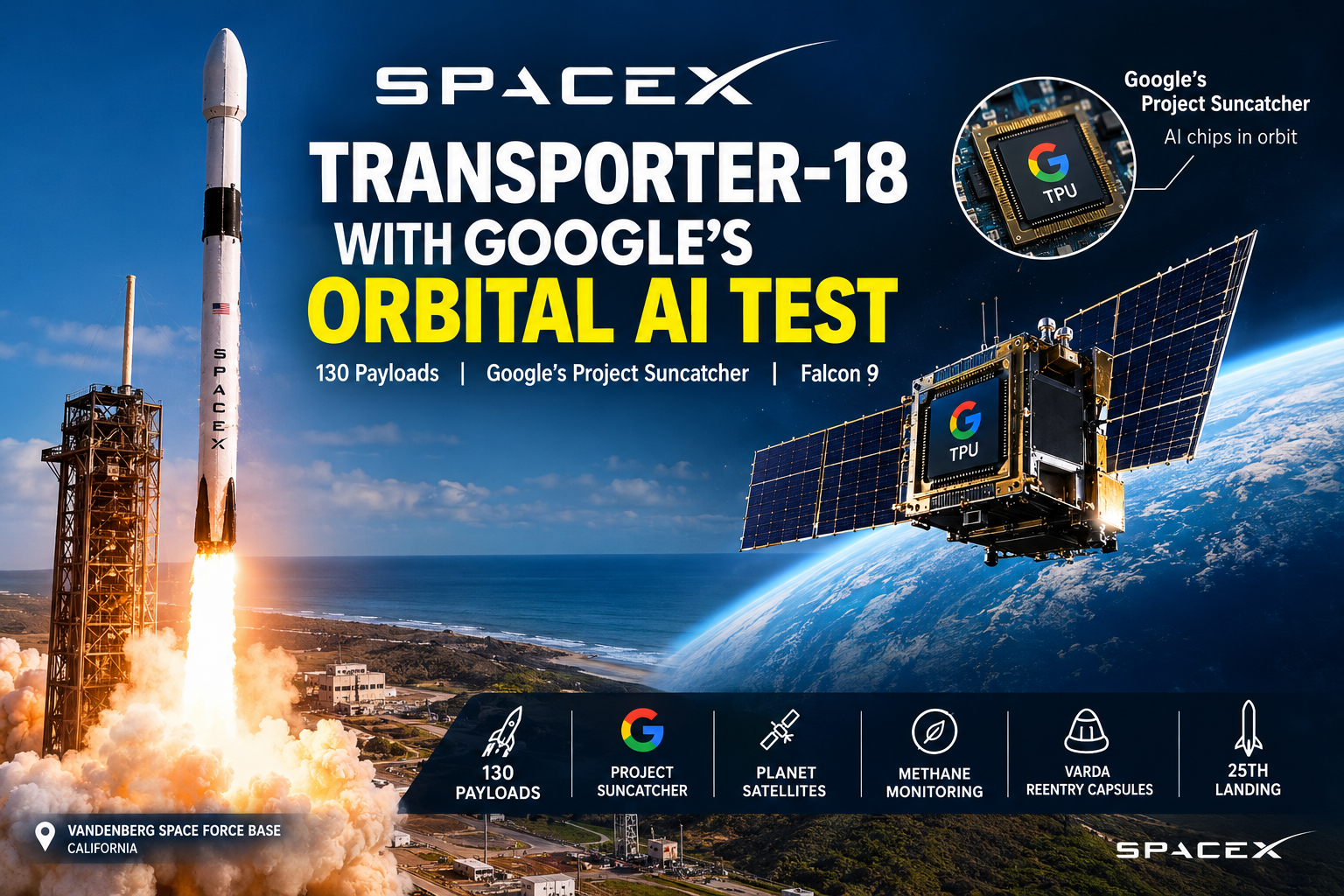
SpaceX has launched its Transporter-18 rideshare mission, delivering 130 payloads to Low Earth Orbit (LEO) from Vandenberg Space Force Base in California.
The Falcon 9 rocket lifted off on 1 October 2026, at approximately 11:22 a.m. PT, carrying a variety of spacecraft and satellites, including some of Google’s projects, that will be placed in a sun-synchronous orbit. In addition, the Falcon 9 first-stage booster made its 25th flight and landed back at Vandenberg.
However, among the numerous spacecraft and satellites launched by SpaceX, one experiment stands out and has attracted much attention: Google’s Project Suncatcher, which will test whether it is possible to use AI computer chips in space.
Google’s Project Suncatcher Will Test Whether It Is Possible to Use AI Computer Chips in Space
Google’s Project Suncatcher is a concept meant to explore the possibility of creating a scalable AI computing infrastructure in orbit.
For the first time, Google will fly a prototype satellite with four Google Tensor Processing Units (TPUs) on board as a Planet subcontractor. In this way, through Project Suncatcher, Google wants to investigate whether such AI computer chips can be used in the space environment.
In addition, the experiment aims to collect information on the characteristics of the radiation, temperature, and other conditions to which such a satellite would be exposed. Google hopes to use these data to further develop the concept of putting AI computing infrastructure in space, where solar energy may be harnessed to provide the satellites with the energy they need.
The company notes that, in particular, the continuous availability of sunlight in a suitable orbit for the satellites would allow generating much more electricity than is possible on Earth.
Why Is Google Interested in Putting AI Computing Infrastructure in Space?
Artificial intelligence is a promising and developing field, and the demand for computer power and electricity is growing exponentially. Conventional data centers are characterized by their high electricity consumption and complex cooling systems. Thus, the idea of using solar power in space to process AI computations may be attractive to Google.
However, at the moment, Google does not plan to create an orbital data center. The main goal of the experiment within the framework of the Transporter-18 mission is to collect data on the operability of computer chips in space. Google’s research lists several challenges for creating an orbital data center, including radiation, cooling, and communication.
One of the Main Challenges of Creating an Orbital Data Center Is Cooling
The main problem of cooling AI computer chips in space is that conventional methods of cooling by circulating air are not applicable in a zero-gravity environment.
Therefore, Google is studying how to use radiators and heat pipes to transfer excess heat from computer chips to the outside of the spacecraft. In particular, the company is testing its cooling technology in a thermal-vacuum chamber to determine whether the technology can withstand the temperature variations in space. Thus, Transporter-18 will also serve as a test of whether Google’s computer chips can operate continuously in a research environment.
Radiation Is Another Problem for an Orbital Data Center That Google Will Study
Radiation poses a serious challenge for any space mission. Thus, for an orbital data center, the issue of radiation resistance of AI computer chips is relevant. According to Google, its Trillium TPUs have been subjected to extensive proton-beam testing to determine their resistance to radiation.
However, ground testing cannot replicate the full range of conditions to which a spacecraft may be exposed in space. Therefore, Google will use the Transporter-18 mission to collect additional data on the operation of its technology in a real environment and compare the results with laboratory tests.
Transporter-18 Will Carry Google’s Satellite, but Also Many Other Spacecraft
In addition to Google’s research and development satellite, SpaceX’s Transporter-18 mission encompasses a large number of other payloads. According to SpaceX, the number of spacecraft and satellites delivered to space during the mission is 130.
Among them are numerous CubeSats, microsatellites, hosted payloads, orbital transfer vehicles, and spacecraft related to reentry missions. Thus, it is possible to note that among the specific satellites of the mission, there are several Planet satellites, including Tangerine-2.
In addition, several spacecraft belong to companies that are developing technologies for maintaining and repairing spacecraft in Earth orbit. According to SpaceX’s manifest, Starfish Space’s Otter spacecraft and Planet’s Tangerine-2 satellite were among the payloads delivered to space by the Falcon 9 rocket during the Transporter-18 mission.
Planet, which owns a significant constellation of Earth observation satellites, also participated in the mission. In particular, Planet’s Tangerine-2 satellite is known to be dedicated to methane observations, and this mission once again demonstrates how such companies use rideshare flights to send their spacecraft to space.
Thanks to such initiatives as SpaceX’s rideshare program, many companies can take advantage of the opportunity to deliver their spacecraft to Earth orbit without spending millions of dollars on a dedicated launch.
Starfish Space’s Otter Spacecraft Will Be Delivered to Space During the Transporter-18 Mission
Another interesting payload delivered by the Transporter-18 mission is the Starfish Space Company’s Otter spacecraft. In particular, SpaceX’s manifest lists the SSPICY Otter spacecraft among the payloads delivered to space by the Falcon 9 rocket during the Transporter-18 mission.
Starfish Space is a company that is developing satellite-servicing technologies that would allow maintaining and repairing spacecraft in Earth orbit.
Varda Space Industries’ Spacecraft Are Also Among the Payloads of the Transporter-18 Mission
In addition to the projects mentioned, the manifest of the Transporter-18 mission also lists the spacecraft of the Varda Space Industries company, which specializes in creating technologies for returning goods from space. Thus, the mission of SpaceX yet once again demonstrates that a large number of different companies are interested in sending their spacecraft to space.
SpaceX’s Falcon 9 Rocket Has Made Its 25th Flight of the First Stage
In addition to the described missions, SpaceX’s Transporter-18 once again demonstrated the possibility of reusing launch vehicles. The Falcon 9 first-stage booster has completed its 25th flight and landed at Landing Zone 4 in Vandenberg. According to SpaceX, the booster had previously been used to launch USSF-62, OneWeb Launch 20, NROL-145, and 21 Starlink missions.
The successful landing of the booster yet once again confirms the reliability of SpaceX’s technology for reusing launch vehicles. The ability to use boosters multiple times has become a key factor in the cost-effectiveness of SpaceX’s rideshare programs.
SpaceX Had a Busy Day: In Addition to Transporter-18, Crew-13 Also Flew, and a Falcon Heavy Was Scheduled to Fly Soon After
Transporter-18 was only one of several SpaceX missions on 1 October. The day also saw the launch of the Crew-13 crewed spacecraft from Florida. In addition, the company’s Falcon Heavy rocket was due to launch the National Reconnaissance Office satellite later the same day. Thus, according to SpaceX’s launch manifest, the Transporter-18 mission was scheduled for 1 October, while the NROL-97 mission was scheduled for 2 October UTC. This shows how busy SpaceX has become with its Falcon rocket fleet.
What Are the Further Steps for Google’s Project Suncatcher?
Transporter-18 is only the beginning of Google’s journey toward creating an orbital data center. In particular, in the future, Google will conduct additional tests to study the feasibility of implementing various technologies within the framework of the Project Suncatcher concept. One of the key points for creating an orbital data center will be the technology for transmitting data between spacecraft using lasers.
Google has announced that it will study this technology further and test it in another mission for 2027. If the technology proves its effectiveness, it will allow creating a network of interconnected spacecraft that would be able to perform distributed computing in space.
What Does the Transporter-18 Mission Mean for SpaceX, and What Does It Mean for the Development of Artificial Intelligence?
The Transporter-18 mission is yet another example of how SpaceX contributes to the development of innovative technologies through its reusable rockets and affordable rideshare programs. In particular, the SpaceX mission demonstrates that a wide range of different organizations can use the opportunities provided by the SpaceX rideshare program. Thus, the SpaceX Flight-105 mission delivered to space not only Google’s research spacecraft but also a large number of other satellites and spacecraft. In addition to technological developments in the field of artificial intelligence, other types of space activities are represented in the mission, from Earth observation to spacecraft maintenance.
In addition, the SpaceX Transporter-18 mission shows how SpaceX contributes to the development of orbital infrastructure through the use of multi-flight Falcon 9 boosters. In particular, the Falcon 9 rocket’s first stage has made its way to its 25th flight and will soon return to the launch pad in Vandenberg. Thus, SpaceX continues to lead in the development of advanced aerospace technologies.
As for Google and the Project Suncatcher, the main goal of this project, which was delivered to space by the SpaceX mission, is to study the characteristics of the space environment in order to use them to create an orbital data center. Therefore, the data collected by Google will allow determining whether such an orbital infrastructure will be technically and economically feasible. However, for now, Google has only taken the first step towards this project, which consists in studying how AI computer chips behave in space. Hence, the Transporter-18 mission served as a test of how Google’s computer chips would behave in the space environment.