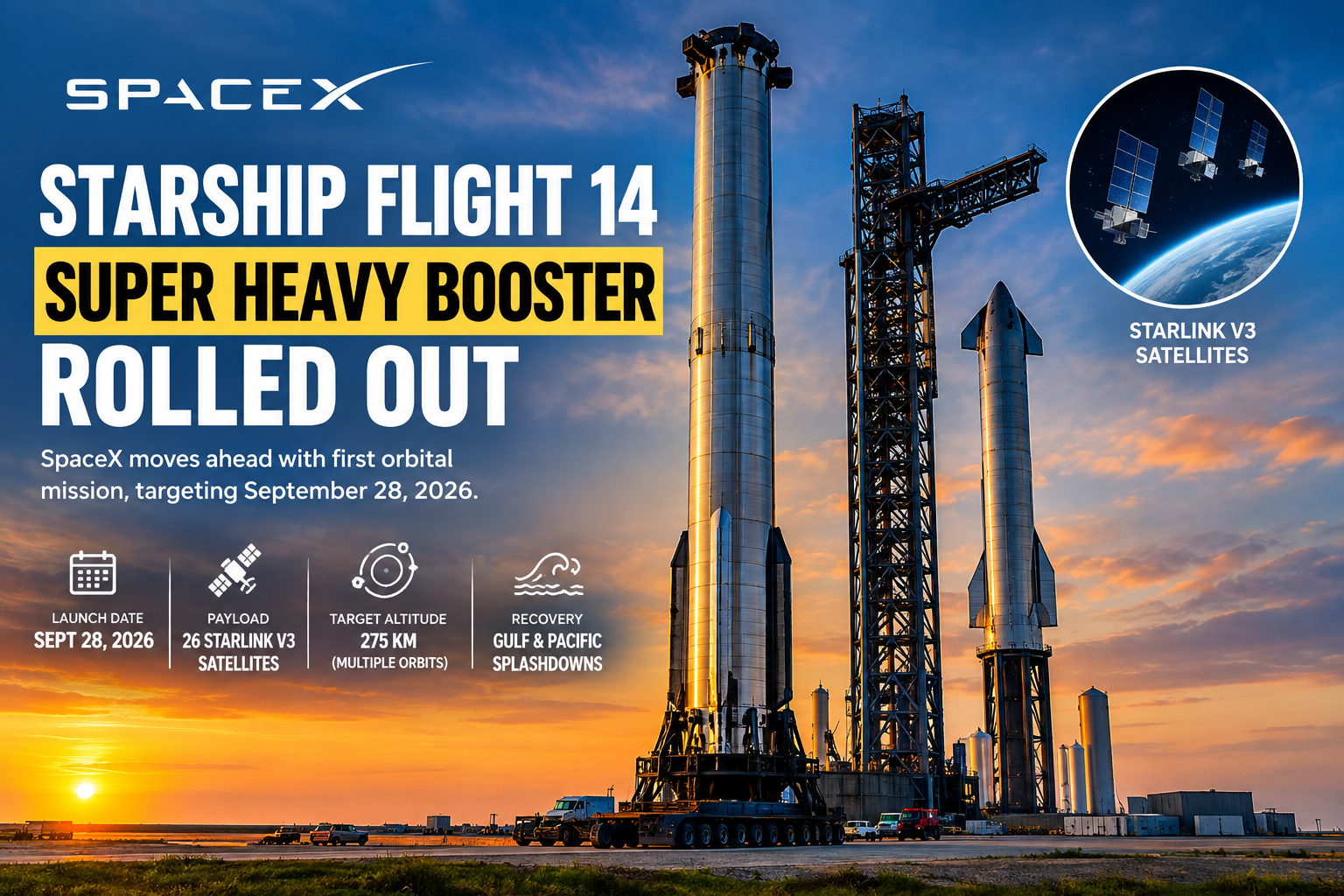
SpaceX has taken another significant step toward its Starship Flight 14, having rolled out its Super Heavy booster at Starbase, Texas, ahead of the company’s first planned orbital Starship flight.
The latest developments come as SpaceX is targeting September 28, 2026, for Flight 14, which the company expects to be greatly different from previous Starship test flights. This is because the company is looking to send the spacecraft into orbit while also deploying operational Starlink V3 satellites.
SpaceX Rolls Super Heavy Booster Toward Pad 2
The Super Heavy booster has been moved from the Starbase production area toward Pad 2, where it will undergo further launch preparations.
The rollout marks an important milestone before the Super Heavy booster is mated with Ship 41, the Starship upper stage assigned to Flight 14.
SpaceX has undergone important tests on the Super Heavy booster, including engine checks and static-fire operations, as the company prepares the vehicle for its next major flight attempt.
The rollout also comes as a visible sign that preparations for Flight 14 are in full swing at Starbase.
Starship Flight 14 Targets September 28 Launch
SpaceX targets September 28 for Starship Flight 14, although launch dates can change depending on testing, weather and regulatory conditions.
The mission was originally targeted for September 22 before SpaceX was forced to change the launch date. According to Aviation Week , the company retargeted the mission for September 28, although regulatory approvals were still in process.
Current launch information lists Flight 14 for September 28 at 12:15 UTC from Pad 2 at Starbase, Texas.
First Starship Mission Set to Reach Orbit
One of the biggest differences between Flight 14 and previous Starship missions is the planned trajectory.
Unlike previous flights, SpaceX intends for Starship to reach an altitude of approximately 275 kilometers and complete multiple orbits around Earth.
Current mission planning calls for approximately six orbits during a flight that would last nearly 10 hours.
If carried out as planned, Flight 14 would represent a major shift in the Starship test program in that the vehicle would change from repeated atmospheric and suborbital demonstrations to an orbital mission profile.
SpaceX Plans to Deploy 26 Starlink V3 Satellites
Another major objective of Starship Flight 14 is the deployment of 26 Starlink V3 satellites.
The satellites are designed to expand the capacity of SpaceX’s Starlink internet network. Current mission information lists the 26 spacecraft as the operational payload for the flight.
This makes Flight 14 particularly significant in that Starship would not only be testing its own flight systems. It would also be carrying an operational commercial payload into orbit.
The mission, therefore, has multiple objectives, with the Starship program looking to test its orbital capabilities, deploy satellites and collect data for future missions.
Super Heavy Booster and Ship 41 Will Splash Down
Flight 14 is also expected to employ a different recovery approach to some previous Starship missions.
Current mission plans indicate that both the Super Heavy booster and Ship 41 are expected to splash down rather than being caught at the launch site.
The Super Heavy booster is planned to return toward the Gulf of Mexico, while Starship’s upper stage is expected to complete its mission around Earth before a controlled reentry and splashdown in the Pacific Ocean.
This approach will enable SpaceX to gather additional flight data while continuing to develop future recovery and reuse systems.
Why Starship Flight 14 Matters for SpaceX
Starship Flight 14 could be an important milestone in SpaceX’s long-term development of a fully reusable heavy-lift launch system.
The company has repeatedly utilized Starship test flights to evaluate its engines, thermal protection system, flight controls, stage separation and recovery technologies.
An orbital mission adds additional factors, including orbital insertion, satellite deployment, spacecraft thermal protection during reentry and controlled splashdown.
A successful demonstration would provide SpaceX with valuable data for future Starship missions and increasingly ambitious operational flights.
What Happens After the Booster Rollout?
Next will come further integration and testing at Starbase.
After the Super Heavy booster has been positioned at Pad 2, SpaceX is expected to continue preparations for the stacking of the booster and Ship 41.
Engine and ground-system checks will also remain key before the launch attempt.
As Starship is still undergoing an active flight-test program, the final launch date could change if SpaceX identifies technical issues or additional testing is needed.
Starship Flight 14: Key Mission Details
| Mission Detail | Current Plan |
| ——————– | ————————- |
| Mission | Starship Flight 14 |
| Launch Vehicle | Starship-Super Heavy V3 |
| Launch Site | Starbase, Texas |
| Launch Pad | Pad 2 |
| Target Date | September 28, 2026 |
| Upper Stage | Ship 41 |
| Booster | Booster 21 |
| Planned Altitude | Approximately 275 km |
| Planned Orbits | Approximately 6 |
| Mission Duration | Nearly 10 hours |
| Payload | 26 Starlink V3 satellites |
| Booster Recovery | Gulf of Mexico splashdown |
| Ship Recovery | Pacific Ocean splashdown |
Mission details are based on current flight planning and are subject to change.
SpaceX Starship Flight 14: What to Watch
Several milestones will be watched closely during the Flight 14.
The first will be whether Super Heavy launches the Starship upper stage and separates as expected. SpaceX will then need to demonstrate orbital insertion and maintain Starship’s trajectory for multiple orbits.
The deployment of the 26 Starlink V3 satellites will be another major objective.
Finally, the spacecraft’s controlled reentry and splashdown will provide important information on Starship’s thermal protection and flight-control systems.
Final Thoughts
The rollout of the Super Heavy booster marks another step toward SpaceX Starship Flight 14, a mission that will see the Starship program take a new step forward.
With a planned orbital trajectory and multiple orbits, along with the deployment of 26 Starlink V3 satellites, Flight 14 is expected to be considerably more ambitious than previous Starship test flights.
SpaceX is now preparing for final vehicle integration, testing and launch preparations at Starbase. If the September 28 date holds, the mission could become one of the most closely watched Starship flights to date.