
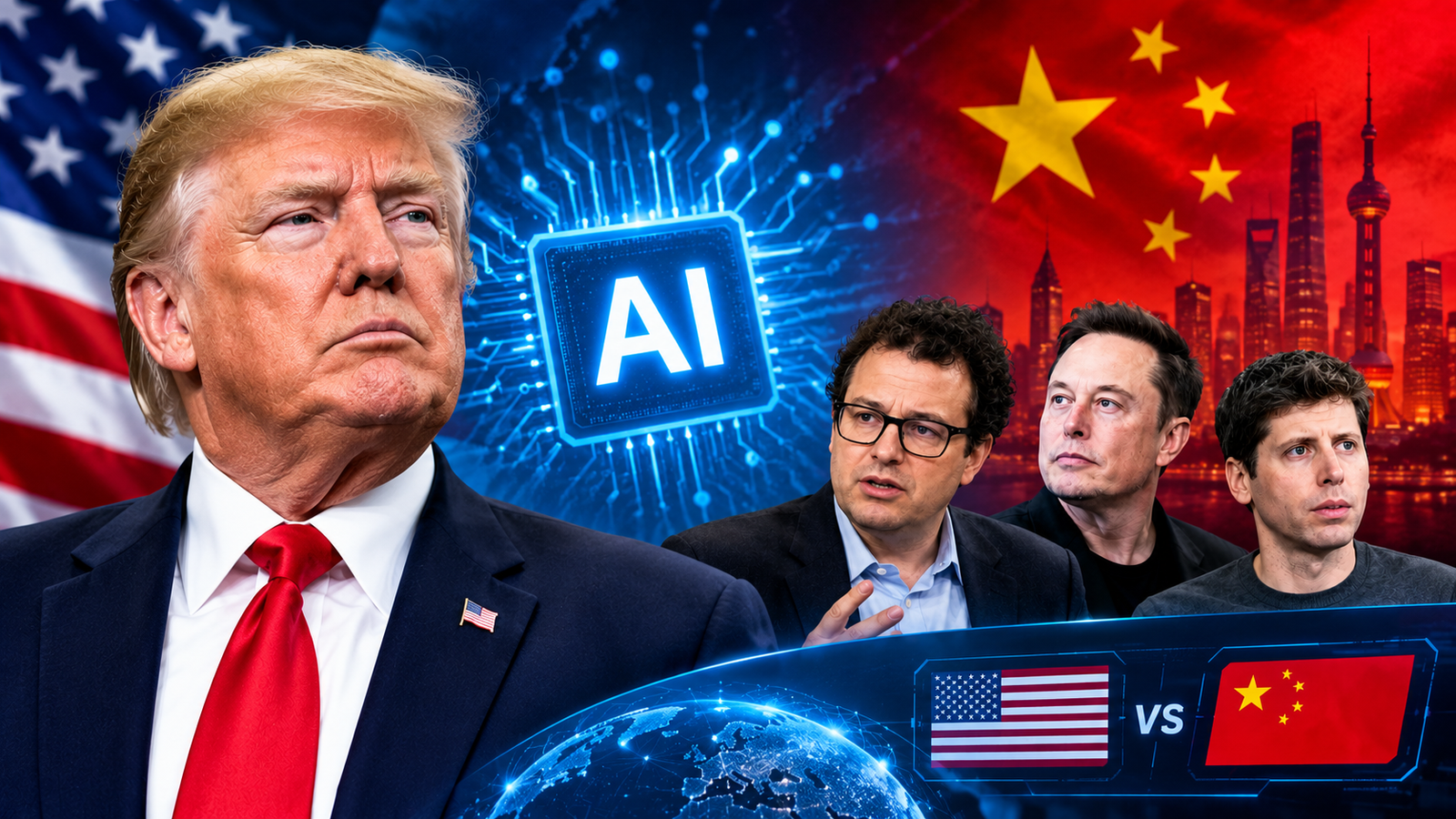
Trump Opposes Calls to Slow AI Development, Warns US Likely to Lose Ground to China
Donald Trump has opposed calls to slow the development of advanced artificial intelligence, arguing the United States cannot afford to give China an advantage in the intensifying global AI race.
The debate of how quickly AI capabilities should be expanded is heating up, with the tensions between AI safety and the speed of the AI competition coming to a head.
Anthropic CEO Dario Amodei has called for a substantial slowdown in the advancement of increasingly powerful AI, stating that safety and oversight measures should be strengthened.
Trump has opposed the idea of the United States slowing the development of artificial intelligence overall, stating that while guardrails may be needed, the United States should not slow its AI progress while China continues to advance its own artificial intelligence capabilities.
Trump Opposes the Idea of a Broad Slowdown in AI Development
The debate around how quickly artificial intelligence should be advanced comes as companies continue to produce more and more powerful large language models that can perform increasingly complex tasks.
Amodei has argued that government and corporate AI safety measures must be strengthened to ensure that as more powerful AI systems are developed and deployed, they do not become too advanced without sufficient oversight.
The proposed measures to achieve this goal include independent monitoring, consistent safety standards and added reviews prior to the release of new and powerful AI systems.
Trump has argued that the risks of a broad slowdown in AI technologies outweigh the benefits.
While a major slowdown in the growth of artificial intelligence capabilities would reduce the amount of innovation produced by American companies, it would also risk allowing China to overtake the United States in the AI competition.
This is the exact reason why Trump has argued that the United States cannot afford to slow the development of AI.
Why Is China a Part of the AI Debate
The United States and China are engaged in a fierce competition to develop artificial intelligence technologies to be used in a variety of applications.
The conflict is not limited to AI chatbots.
It also includes semiconductors, supercomputers, data centers and generative AI models as well as natural language processing and other technologies used in AI computer chips, as well as researchers and scientists.
Therefore, the AI safety and slowdown debate is directly related to the geopolitical struggle between the United States and China, and the balance of power between the world’s two largest economies.
For supporters of the idea of an AI slowdown, the United States needs to ensure that the development of AI does not exceed the ability of society to regulate it.
For those who oppose the idea of an AI slowdown, the United States needs to ensure that it does not fall behind in the artificial intelligence race.
Trump’s position on the debate places him on the side of ensuring the United States keeps pace with the competition.
Dario Amodei Wants Safety Measures to Match the Speed of AI Development
Amodei has become one of the most prominent technology executives to voice concerns about the dangers of the rapid development of artificial intelligence.
While Amodei does not support the notion of a total halt in AI development, he does believe that the current rate at which AI systems are being enhanced and adopted may be outpacing the creation and implementation of safety measures.
Independent monitoring measures could serve as an additional layer of review and oversight, while common standards would limit the ability of companies to update their systems without undergoing additional review and oversight.
The challenge that must be addressed is what the appropriate level of regulation and review should be.
Elon Musk and Sam Altman Weigh In on the AI Slowdown Debate
The AI slowdown debate has attracted the attention of a number of technology executives, with Elon Musk and Sam Altman weighing in on the discussion.
Both men have argued that there should be additional peer reviews conducted between major AI developers prior to the release of powerful new AI systems.
This could allow researchers from different companies to evaluate one another’s work in order to ensure that there are no errors or omissions that a single reviewer may have missed.
However, convincing companies to participate in such a process will prove to be a difficult challenge for those who support it, given the intense competition for dominance in the AI race.
The Argument for an AI Slowdown – Safety First
The argument for an AI slowdown essentially boils down to a discussion of what is more important: the safety of AI systems or the advancement of AI technology.
While policy makers will likely attempt to pursue both goals, in practice it will become increasingly difficult to accomplish both.
Artificial intelligence systems have the potential to become tremendously valuable and powerful, but more capable models also present a number of concerns relating to national security, disinformation, cybersecurity and decision-making algorithms.
This issue has placed increasing pressure on companies to implement additional AI safety measures.
At the same time, it has also caused government officials to express concerns that the United States cannot afford to allow China to overtake American companies in the AI competition.
Trump’s position on the debate essentially boils down to this: he is willing to accept the implementation of AI guardrails, but not comprehensive restrictions that would slow the development of American artificial intelligence systems.
What Does Trump’s Position on AI Mean for American Technology Companies
Trump’s position on the artificial intelligence debate essentially provides general political support for rapid investment in artificial intelligence in the United States.
For major technology companies, this could facilitate the development of new and powerful artificial intelligence systems, as well as data centers and supercomputers.
In addition, Trump’s position may force technology firms to prove that rapid development and powerful AI capabilities can be achieved without sacrificing safety and security.
This could set the tone for the future of artificial intelligence, in which restrictions will apply to specific technologies and processes, rather than blanket restrictions on the entire field.
The Larger Debate – National Security and the Future of AI Development
As the debate over the future of artificial intelligence rages on, it is no longer a matter of if but rather when the subject will take center stage in the presidential election.
This is because the discussion is no longer focused on whether or not artificial intelligence is safe.
Rather, the conflict has shifted to a struggle for dominance in the AI race between the United States and China.
Trump has argued that the United States cannot afford to slow its progress while China advances its own artificial intelligence capabilities.
Proponents of an AI slowdown have argued that advancing the technology too quickly will make it much more difficult to implement appropriate restrictions and safety measures.
Both sides of the debate will likely play a role in shaping the future of the artificial intelligence industry.
Frequently Asked Questions About Trump’s AI Policy
This section contains frequently asked questions about Trump’s AI policy, with detailed answers.
Why does Trump oppose slowing AI development?
Trump’s position on the artificial intelligence slowdown debate reflects his concerns about the United States’ position in the artificial intelligence competition.
He essentially believes that if the United States slows the development of AI capabilities, China will be able to surpass American artificial intelligence technologies.
Does Trump support AI safety measures?
Essentially, Trump supports the concept of AI guardrails, but not to the extent that it would cause the United States to fall behind China in the AI competition.
Who is Dario Amodei?
Dario Amodei is the chief executive officer of the artificial intelligence company Anthropic.
What have Elon Musk and Sam Altman said about AI safety?
Musk and Altman have both expressed support for additional measures to ensure the safety of artificial intelligence systems.
Why is China important to US AI policy?
China is one of the largest artificial intelligence powers in the world, and therefore plays a significant role in the artificial intelligence competition between the United States and its geopolitical rivals.
What are AI guardrails?
AI guardrails are measures designed to ensure the safety of artificial intelligence systems.
They can take a variety of different forms, but essentially involve additional oversight, restrictions and specialized rules for particular aspects of AI technology.

