
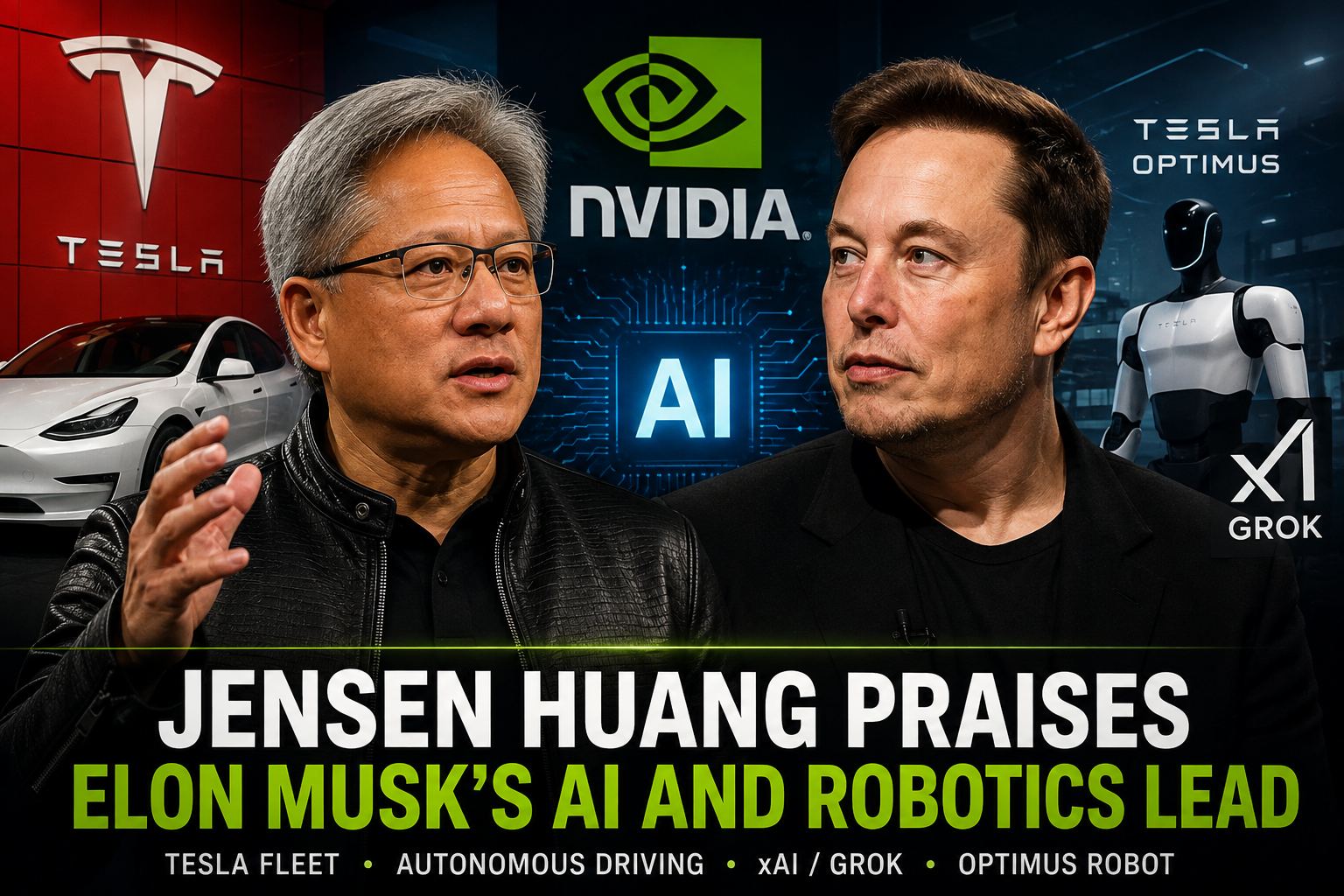
VIDIA’S Jensen Huang Lavishes Elon Musk With Compliments as Tesla Eyes Robotics
NVIDIA CEO Jensen Huang has circled Elon Musk’s “unusual position” in the race for AI dominance due to his access to Tesla’s vast vehicle fleet, AI infrastructure, autopilot systems, and humanoid robotics.
His comments have drawn attention to a growing competition in which companies that can develop large-scale AI models are no longer guaranteed monopolies over AI capabilities, as control over physical machines and data is becoming an equally critical asset.
With his companies Tesla, xAI, and SpaceX, Musk is capitalizing on all three of these areas to make himself a major player in the race for artificial intelligence dominance.
Reasons for Huang’s Positive Statements About Elon Musk
As was reported on the platform covering Jensen Huang’s comments, the NVIDIA CEO described Musk as being in a “phenomenal position” in the race for AI dominance.
One reason for this is that Tesla’s vast vehicle fleet is generating huge amounts of data about the road, which is proving invaluable in developing autopilots.
This is an advantage over other companies, as few have access to such a large fleet of cars that can provide the necessary information for the development of AI.
Another reason for Huang’s positive statements about Musk is that the billionaire entrepreneur is focusing on three major AI areas: xAI’s large-scale AI models, autopilot systems at Tesla, and Optimus humanoid robots at Tesla.
Tesla’s Vehicle Fleet Can Help It Establish Itself as a Major Player in AI
Tesla’s strategy for self-driving cars is based on data, rather than conventional design and development principles.
By using the fleet of cars, Tesla can collect the necessary information about the road, which can be used to improve the capabilities of AI systems, including those used in autopilots.
This is important for the development of self-driving cars, as they must constantly analyze the situation on the road in order to react appropriately.
It is noteworthy that there is a virtuous cycle here: the car gets information about the road, which is processed by AI systems, which in turn helps the car to drive on its own.
If Tesla manages to scale this system, it will be able to accumulate a data set that will allow it to create AI systems that can understand the road and react to it.
In addition, Elon Musk has proposed that AI systems such as Grok can be used to manage large-scale autonomous vehicle fleets in the future.
Optimus Humanoid Robots Can Help Tesla Capitalize on Its AI Dominance
Another compelling reason for Huang’s positive statements about Musk is that Tesla is planning to dominate another market: humanoid robots.
It is noteworthy that the company is considering a truly incredible plan for Optimus, as at the Tesla Q2 2026 earnings call, Elon Musk said that the company is aiming for a production rate of 10 million units per year.
However, he immediately added that achieving this figure would be extremely challenging.
Thus, it should be noted that Musk spoke about 10 million Optimus units as a target, rather than an expectation for the near future.
Meanwhile, Tesla is preparing the necessary infrastructure for the production of humanoid robots at its Texas facility.
According to reports, Tesla is aiming for a much higher production rate for Optimus as its technology matures.
For Elon Musk, the prospect of creating humanoid robots is not only about selling them, as Optimus can become another tool for accumulating data on the capabilities of Tesla’s AI systems.
How Interesting Tesla’s Manufacturing Capabilities Can Be for AI Development
It is this aspect of Musk’s plans for Optimus that particularly interests Jensen Huang.
Humanoid robots require sophisticated AI systems to understand the world around them, manipulate objects, and perform tasks.
At the same time, their production process is expensive and requires automation to produce them at the required rate.
Thus, Tesla is combining several areas at once: AI, robotics, semiconductors, manufacturing, and data.
This is what makes Huang’s comments about Musk so interesting, as Tesla’s vertical integration is a critical factor in the competition for AI dominance.
SpaceX and AI Can Help Elon Musk Achieve Synergy in His Companies
Elon Musk’s plans for AI domination also extend beyond Tesla.
In particular, SpaceX and Tesla are investing billions of dollars in semiconductor manufacturing infrastructure that will be critical to their AI strategies.
In addition, SpaceX and Tesla have joined forces with NVIDIA to develop new computing capabilities, with a particular emphasis on AI applications.
Thus, SpaceX and Tesla have taken a giant step towards securing their future AI needs.
It is noteworthy that SpaceX has also been working with NVIDIA in the field of AI-driven computing, which has also contributed to Huang’s positive statements about Musk.
NVIDIA Can Benefit From Elon Musk’s AI Ambitions
It is noteworthy that NVIDIA is also positioning itself as a key enabler of AI progress.
Jensen Huang’s comments about Musk are therefore interesting, as NVIDIA sells computer hardware to many of the companies dominating the AI race.
The company has seen its market value grow significantly on the strength of its AI business, as its latest quarterly results showed revenues of $96.22 billion and data-center revenue reaching about $89 billion, indicating the demand for such equipment.
This is the context in which Huang’s comments about Musk should be viewed, as NVIDIA not only sells computer hardware to the companies developing large-scale AI models, but also benefits from their successes.
Challenges Ahead for Elon Musk’s AI Strategy
While Huang has positioned Musk as a serious competitor to NVIDIA in the race for AI dominance, it should be noted that he faces many challenges.
Most simply put, building a large-scale humanoid robot factory is much more complicated than building a few prototypes.
Tesla has acknowledged that scaling Optimus production will be extremely difficult, as many of its components will require new supply chains.
At the same time, self-driving cars are another challenge, requiring vast amounts of data, powerful computer hardware, semiconductors, and capital to develop.
Thus, the same Musk strategy that has attracted Huang’s praise will require tremendous effort to bring to fruition.
Summing Up
Jensen Huang’s comments about Elon Musk have demonstrated that the race for AI dominance is entering a new stage.
While previously companies focused on developing the most powerful language models and AI systems, now they are trying to use their resources to create synergies between different areas, from semiconductors to self-driving cars and robots.
Musk has managed to attract Huang’s attention with his plans for Tesla’s vehicle fleet, autopilot systems, and Optimus humanoid robots.
The strategy is bold, as Tesla’s vast vehicle fleet and Optimus can provide the necessary data for the development of AI systems, while SpaceX is working on new chips, and Tesla is investing billions of dollars in AI infrastructure.
However, the key to Huang’s comments is that he sees Musk as a serious competitor to NVIDIA in the race for AI dominance.
While Tesla may have the technology and the ambition, it will have to overcome many obstacles on its way to AI domination.

