
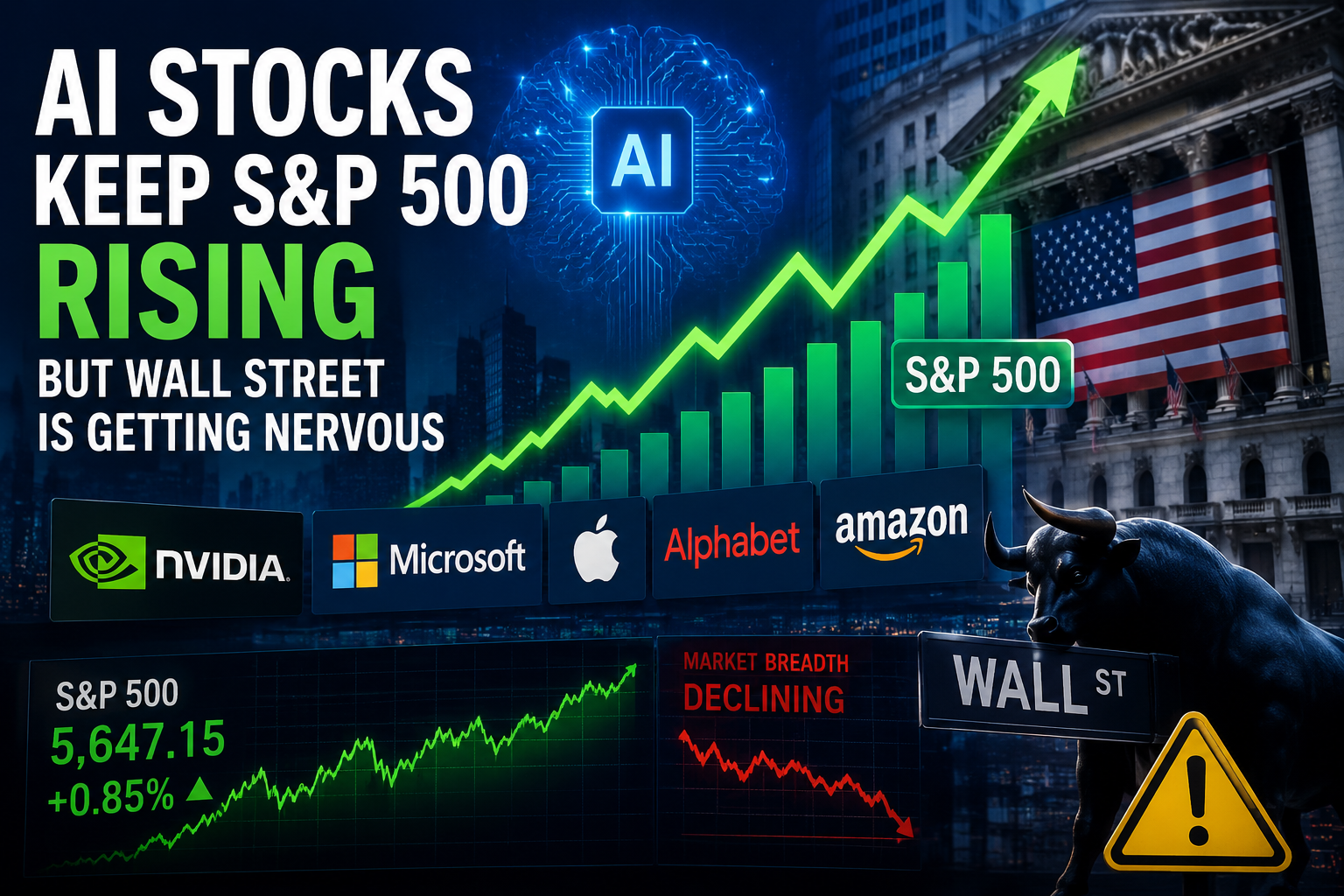
AI Stocks Keep the S&P 500 Strong
The U.S. stock market is seeing an unusual duality in August: the S&P 500 remains strong but a growing number of stocks fail to keep pace.
It’s primarily Big Tech and AI-related companies that are helping keep the market index aloft. Mega-cap issues have outsized impact on the indexes they’re a part of; therefore, strong gains across big technology issues could outweigh weakness across the broader market. ([MarketWatch][1])
That trend is also informing the debate around whether the rally on Wall Street is a broad-based one or is being driven by a few names.
Nvidia leads the charge
Nvidia has stood in the vanguard of market gains.
Having reported strong earnings and an optimistic outlook on revenue, the graphics chipmaker’s shares jumped 8.7% on August 27 to help the Nasdaq and, by extension, the wider S&P 500. ([Reuters][2])
Nvidia has had outsized impact on the market. According to analysis, the company boosted its market value by an astonishing $334 billion after its earnings report on August 27. The value of the entire S&P 500 would have actually dropped that day but for Nvidia’s gains. ([Barron’s][3])
That’s because investors have been placing a lot of their eggs in the basket of individual mega-cap tech stocks.
AI investment keeps tech shares afloat
Investors are very bullish on artificial intelligence.
Nvidia’s guidance has fueled that bullishness, as the market expects that investment in AI infrastructure, data centers and cloud computing will remain strong. It expects 2027 revenue to grow by an incredible 70%, well above several of her previously published forecasts. ([Reuters][2])
The bullishness isn’t limited to hardware. Software companies benefit from expectations of increased adoption of AI across the corporate world. Salesforce saw its shares rally after raising its revenue forecasts, and cybersecurity and other software firms drew the eye. ([Reuters][2])
But the broader market isn’t so lucky.
While the indexes are up, the reality is that the market breadth (the number of stocks that are up versus down) is less appealing.
The S&P 500 had at times gained ground when many individual shares lost ground. It’s a result of the outsized impact on the index by the big technology players. MarketWatch noted that S&P 500 “has seen a number of so-called ‘divergence days,’ in which the index climbed despite many of its component stocks moved lower ([MarketWatch][1]).
That doesn’t appear to be as worrisome, at least not at this particular point in time. Approximately 69 percent of S&P 500 component companies were above their 200-day average, indicating that the overall health of the market is actually pretty good despite the apparent concentration of gains.
However, the contrast between the broad market and the movement of individual companies is of concern to investors.
Interest rates could challenge the AI bullish rally
Technology stock faces another potential headwind in inflation and higher interest rates.
Shares declined on August 28 after Federal Reserve official Kevin Warsh noted the importance of controlling inflation. That helped to fuel expectations of rate stability at the central bank. ([AP News][4])
That’s a challenge for growth stocks because investors discount future earnings, and higher rates make future cash flows look less attractive.
The Nasdaq, which has a heavy concentration of technology players, fell by about of 0.5 percent on August 28, while the S&P 500 dropped by about 0.2 percent. ([AP News][4]) That shows how sensitive the market appears to be to inflation expectations.
Investors are watching out for signs of the market concentration
As the market has become increasingly dependent on a few large companies, the concern is with regard to the sustainability of the rally if AI-leading names turn lower.
The good news for bulls is that so far, companies like Nvidia, Microsoft, Alphabet, Apple and other technology leaders are continuing to report strong earnings and AI-related growth. That should keep the S&P 500 afloat even if small stocks struggle.
But if estimates regarding AI-related investment slow down, the impact will be much more pervasive since these companies represent a significant chunk of the broad U.S. market indexes.
Investors have to differentiate between a health rally and a concentrated one driven by a few components such as individual tech stocks.
What’s next for Wall Street?
Wall Street’s attention is turning to the economy and the Federal Reserve with regard to its ability to control rates. Investors are tracking employment data, inflation and the decision-making of the central bank to determine if and when rate cuts can happen. At the same time, technology companies have to continue performing well. The combination of AI investment, company earnings, inflation and interest rates will be the focus of attention on Wall Street as September draws near.
Summary
The U.S. stock market is seeing strong performance, but it comes with a caveat. The strength of the market index is being driven mainly by AI stocks and mega-cap technology players. Nvidia’s guidance has buoyed investor enthusiasm about the future for artificial intelligence investment, but higher Treasury yields and concerns about the Federal Reserve threaten high-growth stocks. The concern for investors is whether the market will continue to be driven by just a few stocks or whether the broader market will be able to join in as well.

