
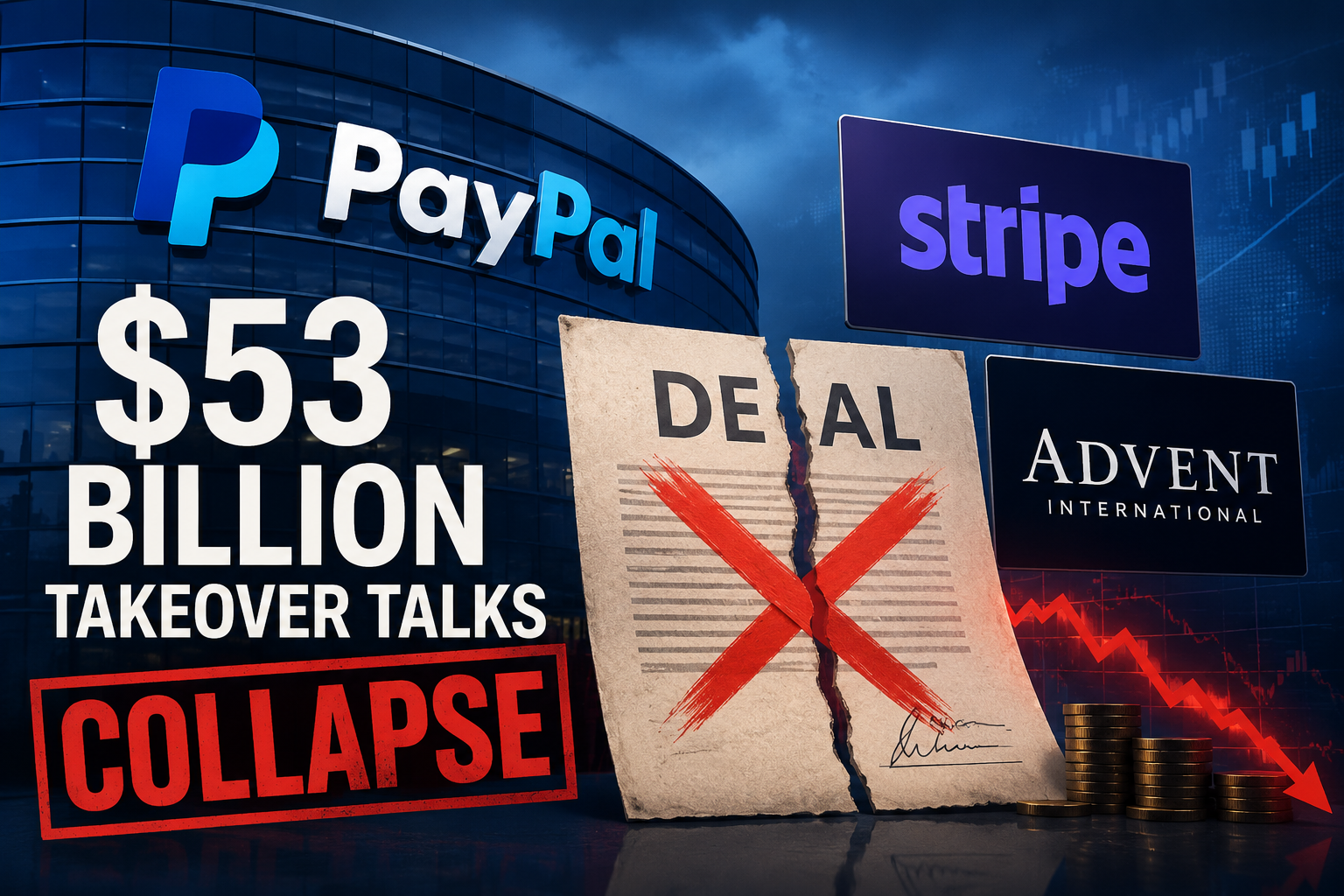
PayPal Takeover Talks Come to an End
PayPal is again on the cusp of an important corporate turning point with the possible end to a reported $53 billion takeover pursuit involving Stripe and Advent International.
The potential transaction could come as one of the largest deals seen in the fintech world, but the talks apparently failed to produce an agreement, leaving PayPal independent in a new light on its corporate future.
For investors and the financial technology industry at large, this turn of events raises the interesting question: what exactly is next for one of the world’s best-known digital payment companies?
Why is PayPal Attracting Buyers?
PayPal has proven to be a major player in online transactions, with its vast customer base, payment structure and brand value all serving as major enticements for any would-be buyers.
Competition in the digital payment space has also become heated, causing a number of companies to look for ways to grow their presence and network in order to capture more of the online retail trade.
A company as substantial as PayPal has the potential to contribute to all of the above considerations.
But, acquiring a firm of PayPal’s magnitude would also be an enormously complicated financial endeavor. Any such buyer has to make sure that the enormous cost is worth the potential long-term payoff while facing all sorts of regulatory, financing and implementation hurdles.
Stripe and Advent International’s Reported Interest
The reportedly involved parties also speak of major players within the financial technology and investment arena.
The reported pursuit would reportedly value PayPal at around $53 billion, placing it in the realm of one of the largest financial technology deals in the sector’s history.
Such a transaction would represent huge potential upside as well as long-term ramifications for the fortunes of any involved payment companies and the financial technology industry as a whole.
But, apparently, the apparent buyers were not able to convince themselves to complete the large acquisition.
It is a fitting demonstration of just how challenging it can be to make an acquisition of a particularly large-scale venture.
why did the $53 billion deal fall apart?
The reasons behind the deal’s demise are certainly interesting, given that no big business purchase typically boils down to just one crucial point.
Among many possible factors influencing the deal, one could include PayPal’s valuation.
PayPal represents an interesting case in financial technology acquisitions due to the fluctuating nature of firms’ valuations in the industry. Anytime investor interests, earnings and market conditions shift, firm valuations inevitably change.
Financing is another major aspect when considering a particularly large acquisition endeavor.
A deal worth tens of billions of dollars would require massive investment, and higher financing costs could change an entire calculation for an interested purchasing entity.
Lastly, in any major payments space deal, the ever-watchful eye of regulators is bound to influence, impede or outright scuttle the endeavor.
A large-scale combination of financial technology companies would certainly draw the close attention of those charged with the responsibility of overseeing the industry’s functioning as well as regulating it.
What does the failed PayPal takeover mean for the company?
The end of discussions does not necessarily represent a bad development for PayPal.
In fact, remaining independent can actually grant the company even more options in its own strategic development.
As PayPal is currently one of the financial industry’s leading players, staying independent allows it to better pursue its own strategy without the added headache of a major acquisition.
At the same time, any potential interference the potential deal’s fallout could cause is avoided as well, and those who had previously purchased company equity can continue operating within their current framework, while those who continue in the corporate ranks will concentrate on improving the firm’s financial outlook and overall performance.
Investors Will Now Pay Increased Attention to PayPal’s Performance
With the purported buyout talk out of the way, investors can now concentrate on how PayPal is doing as a business.
Competition from legacy payment channels, digital wallets and banks as well as up-and-coming digital financial technology firms, is intense.
In such a competitive environment PayPal’s biggest challenge comes in ensuring long-term, profitable growth.
PayPal has, for some significant time, been on an impressive pace at creating value for global payments, but the changing trends are placing more importance on providing swift, secure and hassle-free payment mechanisms across the multitude of payment channels across smartphones, the web and bricks-and-mortar stores.
This means innovative development has to be a constant in its ongoing improvement efforts, as not relying on its well-known name alone may be a key consideration for future success in the competitive digital payments arena.
The bigger picture for the fintech industry
The reported acquisition’s fallout is a reminder of how much financial technology companies that once soared on sky-high valuations can experience today a difficult time in attracting new buyers. The fintech firms which represented the next wave of financial services’ potential growth now face an industry in which investment and market confidence are looking for stronger, more sustainable business fundamentals.
In the past the financial technology sphere often aggressively pursued every potential area in search of growth at any cost. But in times of tighter economic conditions, acquisition seekers are now faced with the need to determine just what the benefits of a targeted purchase might be.
This leaves companies like PayPal with a challenge of their own: demonstrating that they can support current trends and bring new value to the competitive digital payments landscape while simultaneously meeting new investor expectations. The failure to meet them with an imminent, successful business move may cause even more questions to be raised about the company’s growth prospects in the coming months.
Is PayPal Likely to Become a Takeover Target Again?
The fallout of the current set of talk is unlikely to end PayPal being at risk as a target for acquisition.
This company remains one of the industry’s key players, with its reputation extending all over the globe in the digital payments space.
If the firm’s valuation becomes enticing or any buyer is able to find compelling strategic benefits, the company could see a fresh wave of acquisition interest.
But, the reality is that PayPal would need to overcome the same set of issues again if it were to go through with future takeovers. In the meantime, the company seems to remain focused on its own path of independent growth as a leading digital payments provider.
What Happens Next For PayPal?
What is perhaps a more interesting set of considerations comes when it comes to PayPal’s own performance.
The big takeaway from this news, aside from the end of potential buyout speculation, will largely come down to how the company fares at strengthening both its competitiveness and own financial outlook.
The company has several potential options that it can explore: digital commerce platforms, payment processing and merchant services as well as various financial technology offerings.
If PayPal is able to demonstrate consistent growth, its potential future financial outlook can be bright. On the other hand, if its performance falters, the prospect of acquisition speculation could resurface again shortly.
The outcome will be an illustration of just what sort of future for the financial technology and payments industry is necessary if PayPal itself wants sustained value generation for years to come.
With regard to the end of the discussions surrounding the $53 billion PayPal buyout prospect, this is one of the financial technology sphere’s biggest questions with no small number of challenges. Although it is not necessary a sign of an end to PayPal’s history as we know it, its future will undoubtedly depend on just how the company is capable of creating value independently.

