
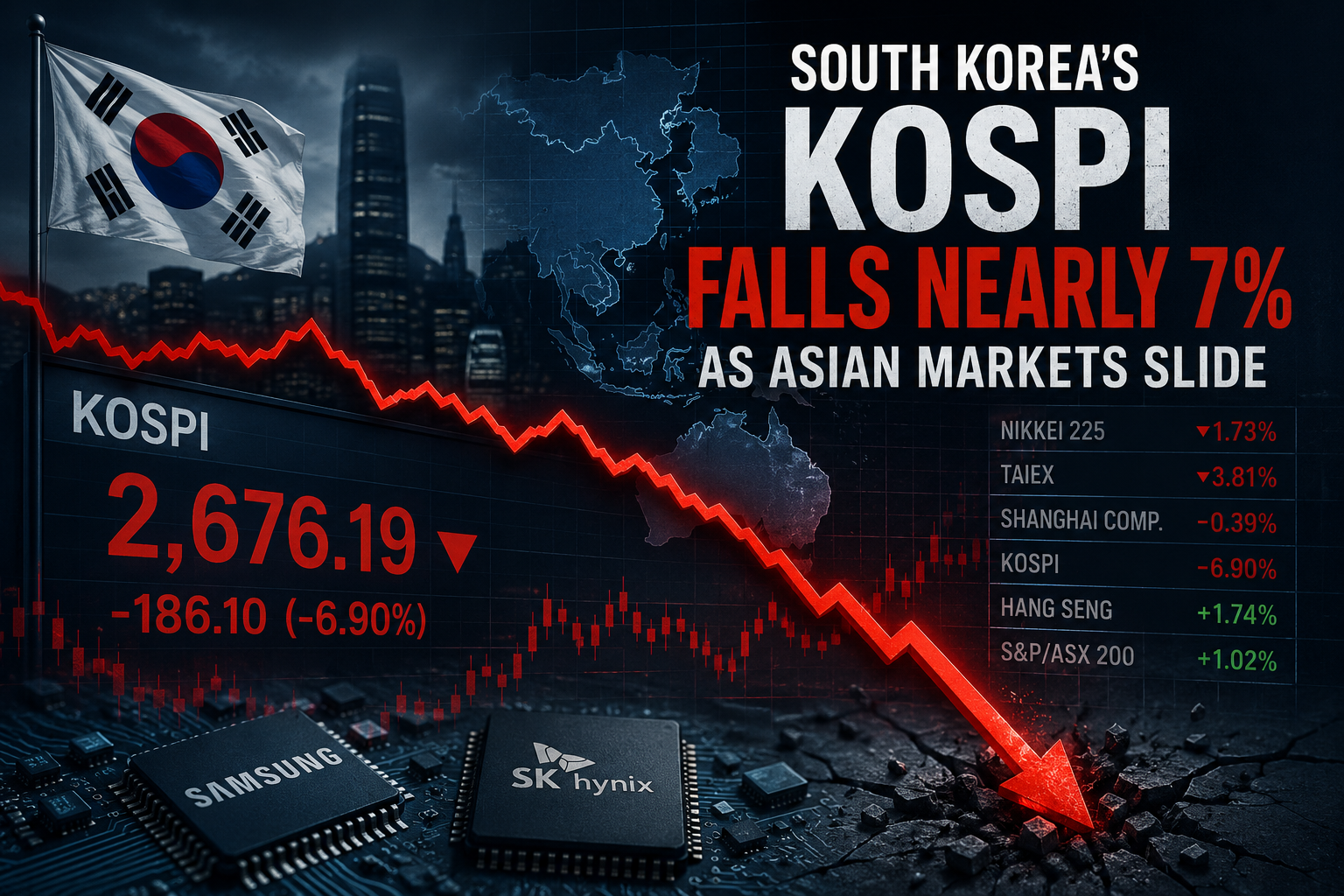
South Korea’s KOSPI Falls Nearly 7% as Asian Markets Sell Off on AI and Chip Concerns
South Korea’s KOSPI stock index dropped nearly 7 percent on Wednesday following a steep sell-off in semiconductor stocks triggered by concerns about inflated investments in artificial intelligence and the sustainability of astronomical valuations in the chip sector. The fall in South Korea’s benchmark stock index sent shockwaves around the region, as investors feared that billions of dollars poured into AI-related technologies may not deliver the expected payoffs.
The sell-off has intensified the pressure on technology stocks in recent trading days, as Samsung Electronics and SK Hynix – two of South Korea’s largest companies – continued to be subject to massive selling pressures. South Korea’s KOSPI is especially vulnerable to fluctuations in the technology sector due to the significant weight of high-tech firms in the index.
Reason why South Korea’s KOSPI fell
The main reason why South Korea’s KOSPI fell nearly 7 percent was fears about the sustainability of the booming interest in artificial intelligence.
South Korea is one of the world’s largest markets for semiconductors, and its benchmark stock index was particularly vulnerable to the sell-off because of its significant exposures to technology firms. Rising concerns about the speculative bubble around artificial intelligence and the technology sector in general led investors to offload tech stocks, with the negative momentum triggering a broad sell-off in the broader market.
Another factor that contributed to the sharp drop in South Korea’s benchmark stock index was a powerful rise in Korean technology shares, which prompted many investors to take profits. As a result, there was a sharp reversal in market psychology as fears grew that the booming valuations of technology firms were not reflective of fundamentals and that the frenzied buying of AI-related assets would soon reverse.
Semiconductor stocks dragged KOSPI down
Semiconductor stocks were at the center of the sell-off on Wednesday. Even though SK Hynix announced a record-breaking quarter, fueled by robust demand for memory products due to artificial intelligence adoption, the positive developments failed to reassure investors, as the stock price continued to tumble under pressure from persistent fears about a speculative bubble in the technology sector.
This development highlights the precarious situation of many technology firms, as even strong performances fail to inspire investor confidence. Many technology companies witnessed their shares plunge despite posting stellar results as concerns mounted that profits would be insufficient to justify their astronomical valuations.
Samsung Electronics was also affected by the pessimism about the prospects of the technology sector as its shares sold off sharply, contributing to the broader market decline. The weakness in Samsung and SK Hynix, in particular, has significantly impacted South Korea’s KOSPI, which is highly exposed to large-cap technology firms.
Asian stock markets also sold off on concerns about artificial intelligence
Other Asian markets also sold off on Wednesday amid growing fears about the technology sector. Japan’s Nikkei 225 and Taiwan’s Taiex each dropped by around 1.7 percent and 3.8 percent, respectively. Meanwhile, China’s Shanghai Composite also posted a decline. However, Hong Kong and Australia were able to post gains as the Hang Seng Index rose by approximately 1.7 percent, while Australia’s S&P; ASX 200 rose by about 1 percent.
While the weakness in South Korea was reflected in other Asian markets as well, some countries posted gains as investors moved to more defensive assets.
Why are concerns about artificial intelligence so detrimental to investors?
The weakness in South Korea and the broader Asian markets reflects investors’ fears about the artificial intelligence boom. Technology firms around the world have invested billions of dollars in data centers and related infrastructure to meet the unprecedented demand for artificial intelligence.
While the frenzy around AI has benefited many technology firms, particularly semiconductor companies, investors have started questioning whether profits would be sufficient to justify such massive investments. The concerns around AI adoption have triggered massive selling pressures as many investors feel that the technology sector is severely overvalued.
Such selling often leads to sharp declines in benchmark stock indices as rising doubts about corporate profitability lead to widespread profit-taking and capital rotation out of the technology sector.
Why is South Korea’s KOSPI highly susceptible to swings in the technology sector?
South Korea’s KOSPI typically experiences large swings due to the strong presence of large tech firms. Technology stocks account for a significant portion of the KOSPI, and any changes in their valuations often lead to large movements in the benchmark stock index.
When investors grow optimistic about prospects in the technology sector, they flock to buy shares of firms in the sector, fueling sharp gains in the KOSPI. However, the same dynamic also works in the opposite direction, with negative news about firms in the technology sector triggering a sell-off in the broader market.
Such a scenario has played out in recent trading days, with investors growing pessimistic about the prospects for the technology sector.
What will happen to Asian stock markets?
Investors will likely keep watching the situation closely as further information about the prospects for AI emerges. The primary focus will be on semiconductor firms’ earnings reports, technology companies’ guidance, and developments around large-scale investments in artificial intelligence. In the short term, investors will be watching whether the recent corrections will continue or reverse as a result of strong performance in the previous weeks.
In the case of South Korea, all eyes will be on Samsung and SK Hynix, which will report their results in the days ahead. The developments in these two firms are likely to determine the future direction of South Korea’s KOSPI in the near term.
As for the other Asian markets, investors will be watching how the weakness in South Korea will impact technology stocks in Japan, Taiwan, China, and the United States.
South Korea’s KOSPI Sell-Off Demonstrates Growing Investor Uncertainty
South Korea’s KOSPI plunged nearly 7 percent on Wednesday as investors sold technology and semiconductor stocks, worried that massive investments in artificial intelligence would fail to produce the promised returns. South Korea’s semiconductor sector is strategically important to the global supply chain, and its prospects have significant implications for world markets. For now, investors are worried about the ability of firms in the technology sector to meet the demand for cutting-edge semiconductors.
However, many investors are starting to question whether the astronomical costs associated with adopting AI will be offset by its benefits. For now, the KOSPI sell-off has raised concerns about technology valuations, especially semiconductor stocks, across Asian stock markets.
FAQs
Why did South Korea’s KOSPI fall nearly 7 percent?
South Korea’s KOSPI dropped sharply as investors sold semiconductor shares amid fears about inflated artificial intelligence and technology valuations and concerns about the sustainability of the recent boom in the technology sector. The sharp decline in KOSPI follows a powerful selloff in tech stocks.
Which firms were affected by the sell-off?
Samsung Electronics and SK Hynix were affected by the sharp decline in tech stocks that triggered the KOSPI to plunge nearly 7 percent.
Were other Asian markets also affected?
Japan’s Nikkei 225 and Taiwan’s Taiex also fell, with Taiex posting the largest loss among Asian markets. China’s Shanghai Composite also dropped. Meanwhile, Hong Kong and Australia managed to record gains.
Why is South Korea’s KOSPI highly susceptible to technology developments?
South Korea’s KOSPI is highly exposed to technology developments, as many of the country’s leading firms are based in the technology sector. As a result, any changes in technology valuations send shockwaves through South Korea’s benchmark stock index, pushing it lower in the case of falling valuations and higher in the case of rising valuations.
Conclusion
South Korea’s KOSPI plunged nearly 7 percent as technology and semiconductor stocks sold off following fears that massive injections of capital into artificial intelligence would fail to produce the expected returns. South Korea’s technology sector currently enjoys robust demand due to the rising adoption of artificial intelligence and the resulting need for cutting-edge semiconductors. However, investors are starting to worry about inflated valuations and the sustainability of the booming interest in technology and artificial intelligence.
What determines the future of South Korea’s KOSPI, as well as the broader Asian stock markets? Everything points to the performance of semiconductor firms and technology companies in general in the near term. If firms in the technology sector report positive developments regarding artificial intelligence, it would have a positive impact on the stock markets. However, anything negative about technology companies’ performance would lead to further losses for South Korea’s KOSPI.

