
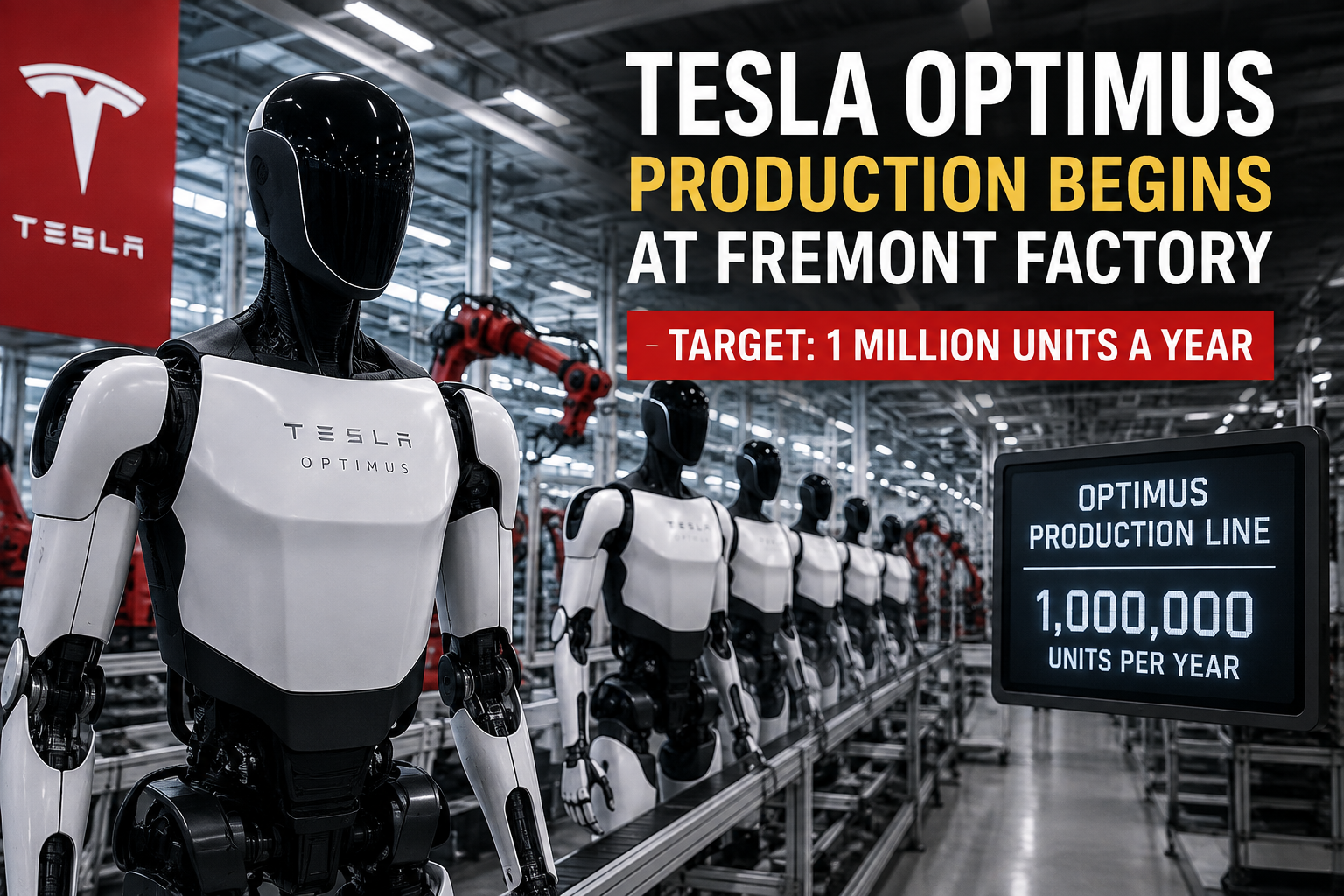
Tesla is shifting towards a new phase for its Optimus humanoid robot at Fremont, CA as it replaces a vehicle assembly line which was previously used for the Model S and Model X. Elon Musk is clearly interested in robotics and artificial intelligence as a potential pillar for the company.
Tesla is prepared to scale up its production of the Optimus humanoid robot at Fremont as part of what could be one of the company’s most significant strategic shifts in history.
The former Model S and Model X production area is being retooled for Optimus, and Tesla has indicated the first-generation production line is aimed at an eventual capacity of 1 million Optimus robots per year.
However, Tesla’s ramping of Optimus production is expected to be a slow process, since building a humanoid robot at scale is significantly more challenging than many of the traditional automotive components it will include.
Tesla Converts Fremont Factory for Optimus Robot Production
Tesla’s Fremont factory has been a center of the company’s electric vehicle production. Now the company looks set to transform part of it for an entirely new product.
The production space previously used for the Model S and Model X is being turned into an assembly operation for Optimus. Tesla has described the Fremont line as its first large-scale Optimus factory, which is designed for an annual capacity of 1 million robots once production reaches full scale.
The move represents a major shift in Tesla’s approach to manufacturing. Rather than focusing its efforts solely on moving into new markets with vehicles, Tesla is investing heavily in robotics, AI and what Musk calls physical AI.
Tesla Optimus Production Will Start Slowly
Despite the size of Tesla’s long-term production target drawing attention, the company is not expected to immediately ramp production to anything near a million units per year.
Tesla executives have indicated that the initial Optimus manufacturing ramp is expected to be relatively slow. During the 2026 earnings discussion, Elon Musk emphasized the difficulty of scaling the robot due to some of the components and systems being new.
Unlike a vehicle, which uses thousands of components supported by the existing automotive supply chains, Optimus requires specialized electromechanical systems, actuators, electronics and highly dexterous hands.
This means Tesla must develop and scale much of the supply chain while also improving the robot.
What Will Tesla Do With the First Optimus Robots?
The first Optimus units are not expected to immediately appear in homes or be available to consumers.
Tesla has indicated that the early production robots will be used to support its own operations, including an internal Optimus training program. The aim is to gather data and improve the robot’s capabilities prior to a broader rollout.
The approach could give Tesla an important advantage.
By operating robots in a controlled environment, Tesla can accumulate information about what the Optimus can do physically, identify any failures and continuously refine its AI systems.
The data could eventually help Tesla develop robots that can perform increasingly broad tasks without being directly controlled by humans.
Why Elon Musk Believes Optimus Could Be Bigger Than Tesla’s Car Business
Elon Musk has consistently positioned Optimus as one of Tesla’s most important long-term opportunities.
The logic is straightforward: the potential market for humanoid robots could extend beyond just a factory setting.
A successful general-purpose robot could potentially handle repetitive industrial work, move materials, assist in logistics and eventually assist with household tasks.
This could potentially open up a huge market for Tesla, if the technology becomes reliable and affordable enough for widespread adoption.
Tesla is positioning Optimus as not just another product, but a part of a broader business strategy which combines artificial intelligence, robotics and autonomous systems.
Tesla’s 1 Million Robot Target Is Highly Ambitious
Tesla’s planned Fremont capacity of one million Optimus robots annually is drawing significant attention, in comparison to the challenges which would be necessary to overcome.
Producing humanoid robots at that scale would require Tesla to solve several of the manufacturing challenges simultaneously.
The robot needs sophisticated hands, motors, sensors, batteries, electronics and software, all of which must be reliable and inexpensive enough for large scale production.
Tesla itself has acknowledged that Optimus could be one of the company’s most difficult products to manufacture at scale. Musk has described the production challenge as significant due to the robot including many new components and requiring a supply chain which is being developed.
Thus, the one-million-unit figure should be viewed as more of a long-term production capacity target rather than an immediate production volume.
The Biggest Challenge: Making Humanoid Robots Reliable
Humanoid robots have made impressive progress, although demonstrations are very different from delivering reliable mass-market products.
A robot may successfully perform a task in a controlled demonstration, but it could struggle when conditions differ.
For Optimus to truly be useful, Tesla needs the robot to have the ability to recognize objects, understand its environment, maintain its balance, manipulate different items and perform tasks consistently.
Reliability is particularly vital in environments such as factories and homes.
Tesla executives have acknowledged the engineering challenge of creating a robot with human-like dexterity which can operate without mechanical failures for long periods of time.
Could Optimus Eventually Enter Homes?
Tesla’s long-term vision is beyond just the industrial applications.
Supporters of Optimus believe that humanoid robots could eventually help people with daily household tasks. Possible applications could include cleaning, carrying items, organizing and performing repetitive chores.
However, this future is dependent on significant technological and economic breakthroughs.
A household robot would need to be safe around people, capable of handling unpredictable environments and be inexpensive enough for typical consumers to afford.
These requirements could make the consumer market a much harder challenge to enter than Tesla’s initial factory deployments.
Price and Manufacturing Costs Remain Major Obstacles
One of the biggest questions surrounding Optimus is just how much the robot will eventually cost.
Tesla has experience using large-scale manufacturing to reduce costs, but humanoid robots bring challenges which do not exist in the same way in traditional vehicles.
The company must make thousands of specialized components work together while maintaining reliability.
If production costs remain high, Optimus could be initially limited to companies which can justify the investment by increasing productivity.
Tesla’s ability to reduce manufacturing costs could be just as important as its ability to improve the robot’s intelligence.
Tesla Faces Competition in the Humanoid Robot Race
Tesla is entering an increasingly competitive humanoid robotics industry.
Companies around the world are developing robots for factories, warehouses and other commercial environments. China, in particular, has invested heavily in humanoid robotics with many companies competing to develop practical machines.
Tesla’s advantage is its experience in AI, batteries, manufacturing and large scale production, but competitors are also making rapid progress and so Tesla will need to demonstrate that Optimus can perform useful real-world tasks rather than just delivering impressive demonstrations.
What Comes Next for Tesla Optimus?
The next major test will be Tesla’s ability to transition from prototype production to repeatable high-volume manufacturing.
The Fremont factory is designed around an eventual capacity of one million Optimus robots annually, while Tesla is also preparing for a much larger future production operation in Texas. Tesla has indicated that its next-generation Optimus production concept could eventually target 10 million robots per year, although that is an ambitious long-term goal.
For now, however, investors and robotics enthusiasts will be looking at several key milestones:
How quickly Tesla is able to ramp Optimus production
How reliable the robots are in real-world environments
How much each robot costs to manufacture
How much work Optimus can produce inside Tesla facilities
When Optimus will become available for commercial use
Whether Tesla is able to maintain its ambitious production targets
Tesla’s Future May Depend on More than Electric Cars
Tesla’s move to retool part of its Fremont factory for Optimus production signifies how dramatically the company’s long-term strategy is shifting. Electric vehicles continue to be central to Tesla, but robotics and AI are becoming significantly more important to Musk’s vision for the company.
The immediate goal is not to put millions of robots into homes overnight, but the more important challenge is proving that Optimus can transition from impressive prototypes to dependable machines which can be made at scale.
If Tesla succeeds, the Fremont production line could become an important milestone in the development of the humanoid robotics industry.

