
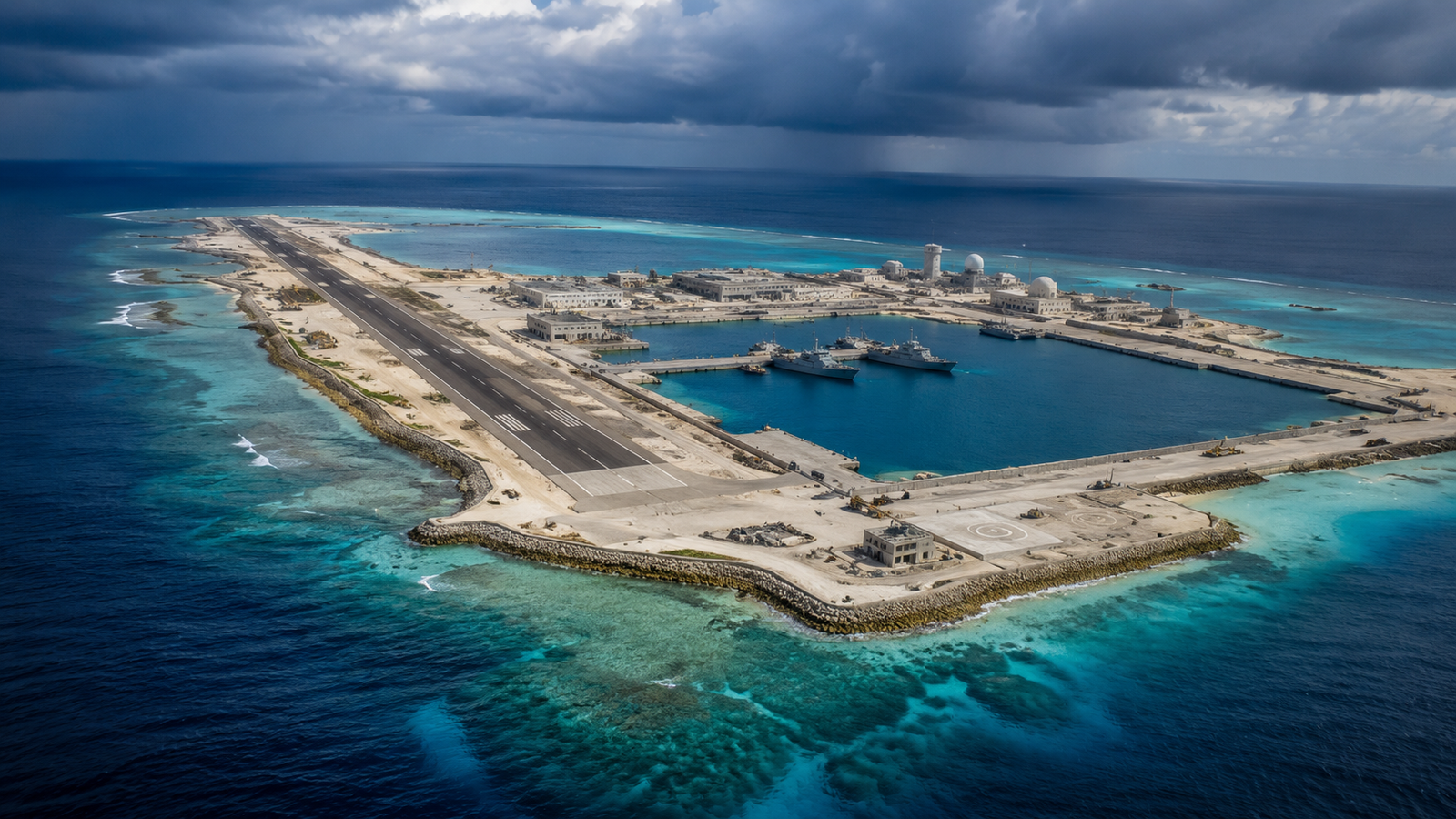
China has finished constructing the first phase of the substantial project in the disputed South China Sea, according to multiple satellite images reviewed by security analysts. The development sees China building on Antelope Reef, a newly acquired Chinese territory that has raised geopolitical tensions and concerns in the region and among the U.S. security analysts.
The construction is significant in this region because it takes place in the Paracel Islands, which is a territory claimed by both China and Vietnam (and which belongs to neither). Although China has controlled the Paracel Islands since 1974, territorial claims are still disputed.
The completed construction phase suggests Beijing’s resolve to fortify its presence in the region, despite attempts by neighboring states to de-escalate regional tensions.
China Completes First Phase at Antelope Reef
According to multiple satellite images reviewed by Reuters, China has finished constructing the first phase at the disputed Antelope Reef. The newly built structure measures nearly 6 km and is thought to possess substantial strategic military value.
Among the structures, analysts have identified a potential runway, a large wharf connected to a deep-water harbor, and a helicopter landing facility.
Notably, the scale of this construction phase has raised multiple concerns because it could transform the barren reef into a significant Chinese military base.
Despite multiple speculations, Beijing has denied that this construction phase targets at building a military base. Instead, China has emphasized that their activity in the region serves scientific and civilian purposes, such as weather observations.
However, outside analysts suggest that China’s investments in the region could offer military options and strategic advantages beyond civilian applications.
Why Antelope Reef Matters?
The South China Sea is one of the busiest maritime routes in the world.
The waterway facilitates international trade and connects many Asian markets with the rest of the world. Furthermore, it is a strategically significant waterway because of its proximity to major shipping lanes and possible military operations. Therefore, a large-scale Chinese military base at the Antelope Reef could allow Beijing to monitor international trade and engage in military operations throughout this critical waterway.
Moreover, analysts have noted that the deep-water harbor could host large naval ships, whereas air installations could provide alternative options for China’s military surveillance and operations.
Therefore, this development possesses strategic significance beyond territorial disputes.
A growing Chinese presence at the Antelope Reef could have geopolitical implications for Vietnam, the Philippines, the U.S., and regional security. Furthermore, increased tensions in the South China Sea could affect strategic partnerships and trade among neighboring states, as well as the involvement of the U.S.
South China Sea Dispute Continues
The South China Sea has been a region of growing tensions among Asian states for several years.
In this strategically significant waterway, China has been disputing territorial claims by Vietnam, the Philippines, Malaysia, Brunei, and Taiwan. In 2016, an international tribunal ruled that China’s nine-dash line had no legal basis under the United Nations Convention on the Law of the Sea. However, Beijing has rejected this ruling, and since then, has continued to build its artificial islands and military infrastructure in the region.
Moreover, territorial disputes have resulted in multiple standoffs among coast guard, naval, and military vessels, as well as skirmishes between rival states.
The recent developments concerning the Antelope Reef construction have added to the already-growing tensions among Asian states.
Vietnam Watches China’s Expansion Closely
Vietnam is highly concerned about China’s growing militarization and territorial claims in the South China Sea. This apprehension is justified, considering that Antelope Reef belongs to the Paracel Islands, a territory with extensive Vietnamese claims. Therefore, any further territorial expansions by China in this region could raise serious security concerns for Hanoi.
Furthermore, Vietnam has been enhancing its defense and military capacities, which suggests that Hanoi is preparing for potential confrontations in the South China Sea. Recently, Vietnam has invested heavily in its naval infrastructure and possesses ambitions to build more sophisticated warships for regional disputes.
Thus, the combination of growing Chinese militarization and Vietnamese defense spending could lead to more security tensions in the South China Sea. Nevertheless, both states benefit economically from regional stability and avoid direct large-scale military confrontation for now.
A Growing Concern for the United States
The recent development could also affect U.S.-China relations. Although Washington does not possess territorial claims in the South China Sea, American foreign policy has prioritized securing free international trade and promoting the rule of law in this region. Additionally, the U.S. has engaged in multiple defense agreements with its regional allies, such as the Philippines.
Recently, U.S. and Filipino militaries have observed multiple heightened tensions between China and the Philippines in the South China Sea. These incidents further strained U.S.-China relations and increased defense spending in the region. According to the Council on Foreign Relations, in July 2026, China and the Philippines have clashed several times around the disputed territories. Furthermore, the U.S., the Philippines, and Japan have held joint military exercises near the South China Sea.
Therefore, China’s growing military presence in the Antelope Reef could become yet another issue fueling the already-worsening U.S.-China relations.
Could the Reef Become a Major Military Base?
One of the most pressing questions surrounding this development concerns the potential strategic and military applications of the newly built structures on the Antelope Reef.
Although satellite images suggest that Beijing could use the newly built facilities for military purposes, analysts still speculate about the potential use of this territory by China.
Notably, the potential runway, deep-water harbor, and helicopter facilities at the disputed reef suggest that China could use the site for expanded surveillance, as well as for naval and air operations.
The experts note that China’s artificial islands in the South China Sea have presented substantial strategic advantages to Beijing, enabling them to operate with increased persistence in this region. For example, the Japanese Defense Ministry has warned that China’s South China Sea activities could boost the capabilities of its air-force operations in the region.
Thus, the extent of China’s strategic use of Antelope Reef depends on whether and how they utilize this territory.
Regional Tensions Are Already Rising
The developments in the South China Sea appear to suggest that tensions across the region are already rising. Notably, China and the Philippines have had multiple standoffs in the South China Sea, whereas Vietnam has been bolstering its military and maritime capabilities. Moreover, the U.S., the Philippines, and Japan have conducted multiple joint exercises to ensure free international trade and counter China’s rising military presence in the South China Sea.
Furthermore, analysts have suggested that this competition between China and its regional neighbors for territorial supremacy could enter the grey zone of conflict. In other words, these states could use coast guards, naval militias, maritime and air surveillance drones, and other unconventional military assets to confront their rivals. Such actions could raise regional tensions and create more incidents, which could lead to full-scale military conflicts if regional governments resort to military options due to domestic political pressures.
What Happens Next?
The completion of China’s first construction phase at the Antelope Reef is unlikely to signal the end of this development. Instead, the future of this artificial island depends on whether and how China continues to build upon the already constructed facilities.
For now, regional states should consider strategic options available to them. For example, Vietnam and the Philippines have the ability to enhance their regional alliances and leverage international support to counter China’s growing influence. Furthermore, the U.S. and its regional allies can reassure territorial integrity and observe free international trade in this region. Nevertheless, it is crucial that these states engage in direct negotiations and diplomatic discussions, rather than resort to military or economic measures.
Although ASEAN members have been working on establishing a binding Code of Conduct for the South China Sea, negotiations have been slow relative to the rapid developments in this region.
Why This Matters Globally
The South China Sea is no longer exclusively a territorial dispute between Asian states. Instead, it has become an international affair because this strategically significant waterway facilitates much of international trade.
Therefore, the construction of the Antelope Reef by China suggests that Beijing intends to establish a persistent military presence in this region. Analysts suggest that this activity has the potential to alter geopolitical balances among regional states. For example, if China continues to expand its military presence in this region, Beijing will possess greater surveillance and strategic depth across the South China Sea. Other states can counter this growing influence by bolstering their military and diplomatic options. Thus, this dispute will continue to create tension among international powers for the foreseeable future.
For now, the completion of China’s first construction phase at the Antelope Reef serves as yet another reminder of the significance of the South China Sea in international geopolitics.
As China builds up its military presence, regional and international states will be watching closely to see whether the new structures will bring new tensions.

