
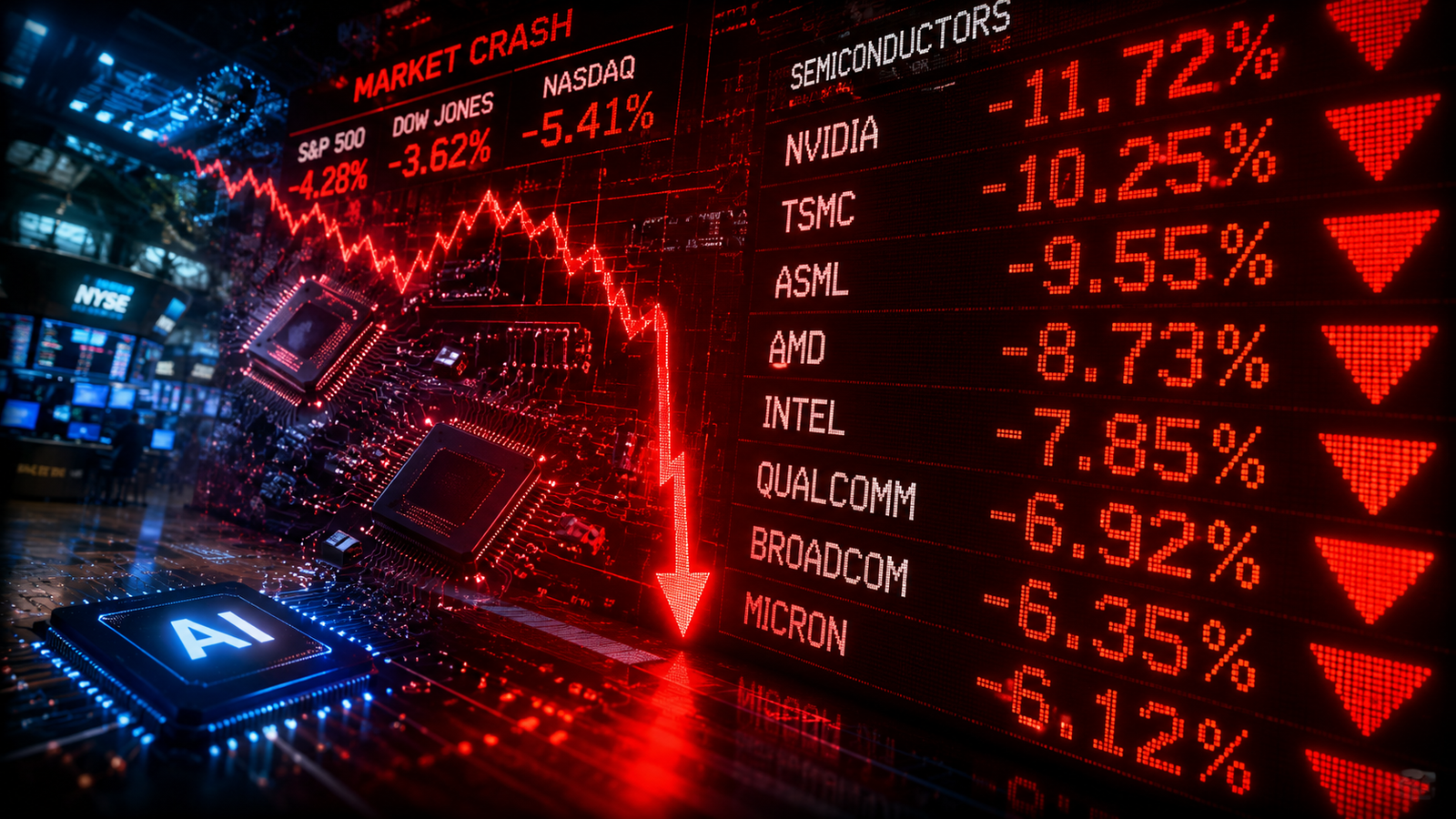
Nasdaq-100 Correction : A brutal, multi-day rout in semiconductor and memory stocks has dragged the tech-heavy Nasdaq-100 into correction territory, as investors grow increasingly skeptical about the payback on hundreds of billions of dollars in AI infrastructure spending.
The Nasdaq-100 fell 1.8% on Tuesday, extending a four-session slide that pulled the index more than 10% below the record high it set in early June — the textbook threshold for a market correction. Micron Technology and Advanced Micro Devices each dropped roughly 8% as the sector-wide selloff deepened.
Where the Selling Started
The selling kicked off overnight in Asia, hitting markets in South Korea, Japan and Taiwan before spreading to U.S. trading, where Dell Technologies tumbled 8% and Intel shares slid 6%. South Korea’s Kospi index closed down nearly 11% on Tuesday — its eighth circuit-breaker trigger of 2026 and one of its worst sessions of the year — as the country’s volatile retail-trading culture helped spread the panic westward. Losses were steep across the board: SK Hynix plunged nearly 15% and Samsung Electronics fell more than 13% at the close in Seoul.
In the U.S., the damage was concentrated almost entirely in chip names. The VanEck Semiconductor ETF, which tracks the Philadelphia Semiconductor Index, has now fallen for four consecutive sessions and dropped more than 3% on Tuesday alone, erasing roughly 12% of its value since its July peak — its worst monthly performance since 2022. Nvidia, the index’s largest component, fell more than 4%.
China Competition Reignites AI Doubts
Analysts point to a specific trigger: a blockbuster Shanghai IPO from Chinese memory chipmaker ChangXin Memory Technologies (CXMT), which rattled investors who had assumed domestic Chinese manufacturers remained structurally behind in advanced memory production. Shares of SanDisk and Western Digital also sold off sharply as investors reassessed the memory sector following CXMT’s debut, in which the stock surged 466%.
That news landed on top of already-jittery sentiment about AI capital spending. “The AI trade is being looked at with a much greater degree of skepticism, and the shift in sentiment means it has become something of a one-way trade with things getting sold unmercifully,” said Mark Luschini, chief investment strategist at Janney Montgomery Scott, describing the mood among investors.
A Split Market
While chipmakers bled, the broader market told a different story. The Dow Jones Industrial Average gained more than 500 points, or about 1.1%, as money rotated out of high-multiple technology names and into industrials, energy and financial stocks.
Notably, Apple — which has largely avoided the industry’s massive data-center buildout — was a rare tech winner. Shares rallied about 1% Tuesday, briefly pushing Apple’s market value above $5 trillion for the first time, only the second time any company has hit that milestone, and the move also put Apple ahead of Nvidia as the world’s most valuable public company; Nvidia finished roughly flat at a $4.77 trillion valuation, versus Apple’s $4.95 trillion.
Is the Panic Overdone?
Not everyone agrees the fundamentals justify the selloff. Despite the sharp equity declines, memory chip prices themselves have kept climbing rather than falling — third-quarter DRAM contracts are settling 20% to 30% higher this month, and Google and Meta have locked in five-year supply contracts, with analysts not expecting meaningful new capacity until 2028. That disconnect suggests the selloff may be driven more by valuation nerves and sentiment than by any actual deterioration in AI-related demand.
The scale of spending underpinning the AI boom remains enormous. JPMorgan projected on Friday that AI-related capital spending will approach roughly $870 billion by the end of 2026, a 77% jump from a year earlier, with hyperscalers Amazon, Meta, Microsoft and Alphabet accounting for about $750 billion of that total, according to Fabio Bassi, the bank’s head of cross-asset strategy.
What Comes Next
The timing puts intense pressure on this week’s earnings calendar. Microsoft and Meta Platforms are due to report Wednesday, followed by Apple and Amazon on Thursday, and their capital-expenditure guidance is expected to move markets both immediately and over the coming quarter. Investors will be watching closely for signs that AI revenue is materializing quickly enough to justify the spending pace — a verdict that could determine whether this correction proves brief or marks the start of a deeper reassessment of the AI trade.
This is not the market’s first brush with a correction this year. The Nasdaq previously fell into correction territory in March 2026, part of a broader rout that wiped out roughly $17 trillion in value across global markets. Whether this latest episode follows a similar pattern of sharp decline and recovery — or evolves into something more prolonged — is likely to hinge on the earnings reports landing this week.

