
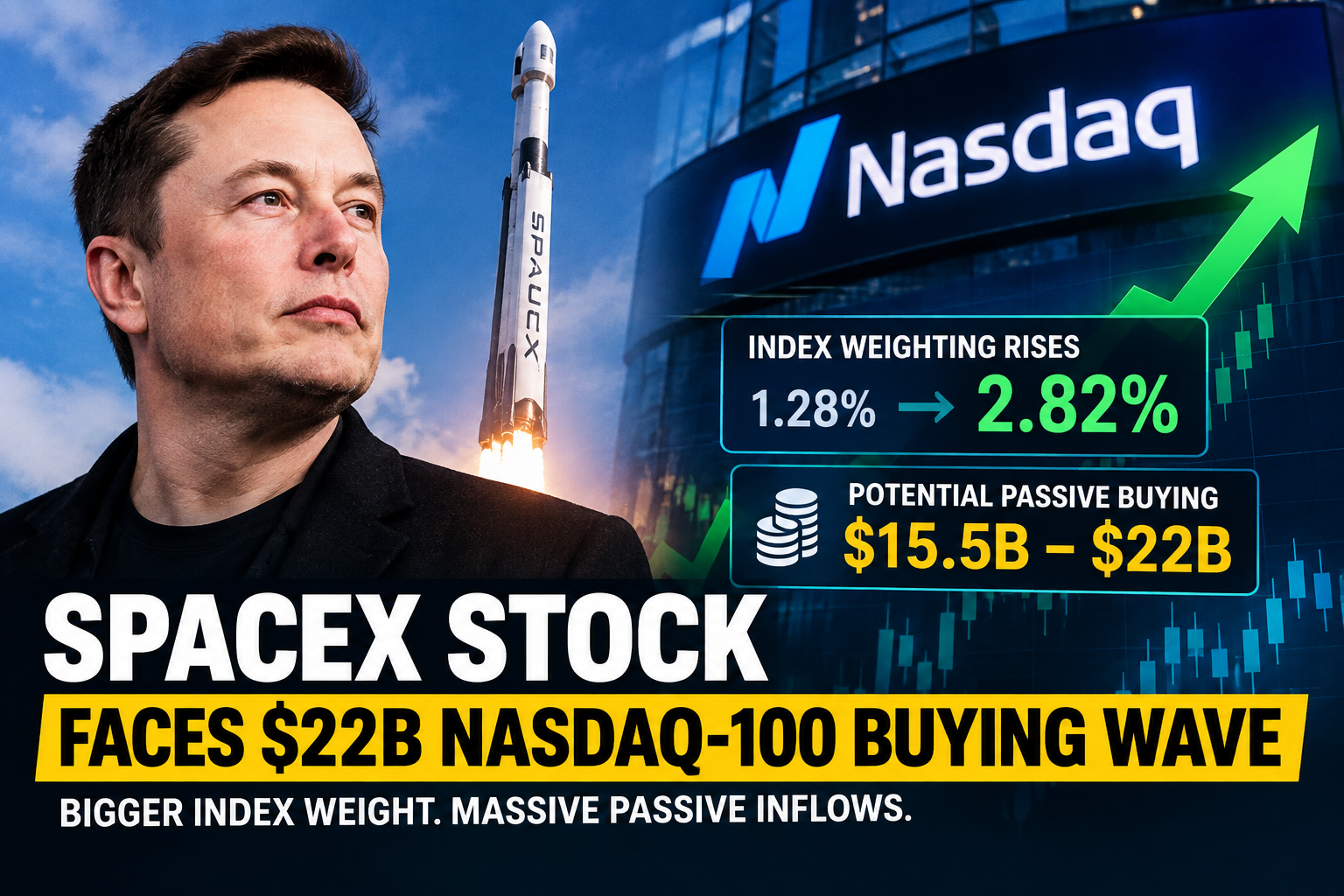
SpaceX stock is undergoing a large wave of automatic buying due to the company’s Nasdaq-100 weighting doubling. The increase may channel between $15.5 billion and $22 billion into the company through index-tracking funds.
The increase in weight follows post-IPO lockup expirations increasing the number of SpaceX shares available for public trading. The Nasdaq-100 rebalance is scheduled to take effect Monday, September 21, 2026. Much of the required portfolio adjustment is expected to occur during Friday’s September 18 closing auction.
SpaceX Nasdaq-100 Weight to Rise From 1.28% to 2.82%
The weighting for SpaceX in the Nasdaq-100 is expected to increase from approximately 1.28% to 2.82%.
The change is primarily related to the expansion of the public float for SpaceX shares after expirations of post-IPO lockups. Increased shares being freely tradable allows the company to obtain a larger weighting under the methodology of the index.
SpaceX originally joined the Nasdaq-100 in July 2026 as part of its IPO. However, the relatively small public float at the time limited its representation in the index despite the company’s massive market valuation.
The latest adjustment therefore represents an increase in weighting, not an initial inclusion.
Up to $22 Billion in Passive Buying
The upcoming rebalance could lead to one of the largest single-day passive buying events occurring in relation to SpaceX stock.
The estimated buying requirement is between $15.5 billion and $22 billion.
Funds that track the Nasdaq-100 are obliged to adjust their holdings based on the new index weighting. This includes major exchange-traded funds, such as the Invesco QQQ Trust, meaning that the purchases are driven largely by index mechanics, as opposed to portfolio managers deciding that the stock is undervalued.
The majority of the activity is expected to occur around the 4 p.m. ET closing auction on September 18.
In comparison, SpaceX’s initial Nasdaq-100 inclusion in July was expected to generate roughly $4.3 billion in passive buying, which would mean that the current rebalance represents a substantially larger potential flow.
Why SpaceX’s Index Weight Is Increasing
A primary driver of the increase in weight is related to SpaceX’s public float.
When initially entering the Nasdaq-100, only a relatively small percentage of its shares were freely available for trading. This limited the effective representation in the index.
Two post-IPO lockup expirations occurred in August, which are reported to have released in excess of 1.2 billion shares into the tradable pool. Major investors retaining their position allowed SpaceX’s float to increase without necessarily generating an equivalent wave of selling.
The increased float has allowed for a substantial increase in SpaceX’s Nasdaq-100 weighting.
SpaceX Nasdaq-100 Rebalance at a Glance
Metric Current Rebalance
Previous SpaceX weighting ~1.28%
New weighting ~2.82%
Estimated passive buying $15.5B–$22B
Previous July buying estimate ~$4.3B
Closing auction September 18, 2026
Rebalance effective September 21, 2026
SpaceX Stock Price Nears $155
SpaceX shares recently closed around $154.81, according to market reports, after another strong session for the stock. Barron’s reported a 2.6% gain to $154.81 on Thursday, with SpaceX shares remaining volatile since the firm’s IPO in June. Since going public, the stock has oscillated widely, reflecting the significant interests of investors in SpaceX’s combination of rocket launches, Starlink satellite communications and artificial-intelligence-related ambitions.
However, the Nasdaq-100 rebalance should not automatically be interpreted as an endorsement of the valuation of SpaceX.
Passive Buying Does Not Guarantee a Higher Stock Price
The size of the expected inflow could draw a lot of interest, but the index-related buying is fundamentally different to that of an investor making a long-term decision based on corporate fundamentals.
Index-tracking funds are obliged to adjust their portfolios when the benchmark changes, therefore their purchases are designed primarily to replicate the index. That means the buying pressure can be substantial but temporary.
SpaceX’s July Nasdaq-100 inclusion provides an important example, with the stock reportedly declining by more than 6% on the day despite an estimated $4.3 billion in forced buying. Those that had accumulated shares ahead of the event could sell into the increased liquidity generated by the index funds.
Traders will therefore be watching to see if September’s much larger rebalance causes a similar pattern or a different market reaction.
SpaceX Fundamentals Remain in Focus
Aside from the mechanics of the Nasdaq-100, interest in SpaceX’s underlying business remains in focus.
Reporting recently points to strong growth across the firm’s operations, including its Starlink, launch services and artificial-intelligence infrastructure. Barron’s recently reported continued investor interest in SpaceX as demand for AI remains high and Starship development is also attracting attention ahead of its next test flight.
Starlink is another major component of SpaceX’s story, with Reuters recently reporting that Starlink has grown to approximately 12 million users and is expanding beyond traditional satellite broadband into wireless connectivity.
These longer-term developments represent aspects beyond the mechanical impact of an index rebalance.
Upcoming Lockup Expirations Could Add More Supply
Another aspect that investors are watching is the next series of SpaceX share lockup expirations. Market reports indicate that more than 2.3 billion restricted shares could become eligible for trading during late October and November. That could represent a significant change in the supply of SpaceX shares.
Whether these shares actually enter the market will depend upon the decisions that the existing shareholders make. An increase in eligible shares does not necessarily mean that all will be sold.
What the Nasdaq-100 Rebalance Means for SpaceX Stock
The September Nasdaq-100 rebalance represents an unusually large technical event for SpaceX. The weighting for the stock is expected to rise from approximately 1.28% to 2.82%, potentially requiring billions of dollars of purchases from passive funds. Much of the activity is expected to concentrate within Friday’s September 18 closing auction, with the new weighting becoming effective September 21.
However, the event should be viewed separately from SpaceX’s long-term business outlook.
The passive buying is driven by index methodology and portfolio tracking, not necessarily a new fundamental valuation assessment for SpaceX.
Investors will therefore be watching two different stories: the short-term impact of billions of dollars of mechanical buying and the longer-term performance of the firm’s businesses, including Starlink, launch services, Starship and AI infrastructure.
The reaction of the stock after the rebalance and how the market absorbs future increases in tradable shares could give additional information in relation to supply, demand and sentiment for the newly public company.

